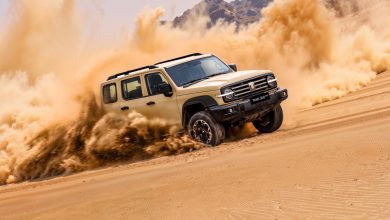
GWM has officially dropped the first factory images of a heavily revised Tank 300 for 2027, confirming another comprehensive update for the boxy off-roader ahead of its Chinese market launch. While the Australian range has only just expanded to include the four-cylinder 2.4-litre turbo-diesel and the 2.0-litre Hi4-T plug-in hybrid, this incoming Chinese refresh pushes the platform’s technological footprint even further, highlighted by a massive battery upgrade and roof-mounted LiDAR.
Visually, the updated Tank 300 adopts a harder, more utilitarian edge. The front fascia ditches the established corporate logo in favour of bold, all-caps ‘TANK’ lettering across the grille. The redesigned front bumper now features exposed structural fasteners and heavy-duty towing recovery points, directly mirroring the aesthetic of the hardcore Hooke Edition prototype shown at Auto Shanghai last year.
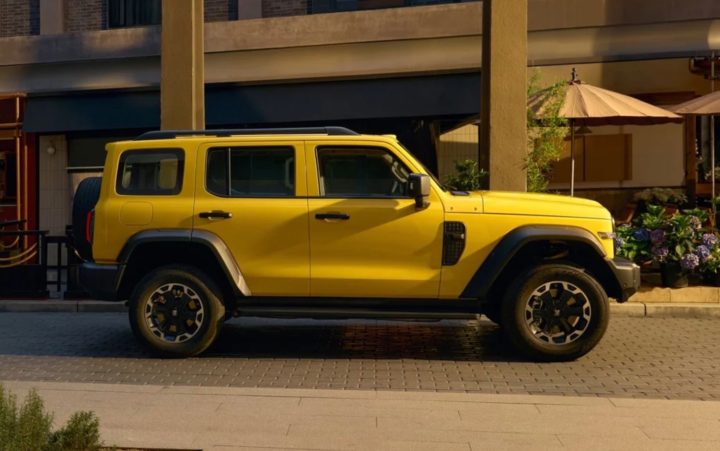
Crucially, the revised bumper also trims the front overhang, actively improving the vehicle’s approach angle for better off-road clearance. Up top, an extra bump above the windshield houses a new LiDAR unit, integrating GWM’s advanced Coffee Pilot Ultra autonomous driving suite.
Under the skin, the dimensional changes are substantial. Homologation filings reveal the updated Tank 300 has grown in every direction. It now measures 4886mm long, 1984mm wide, and 1927mm tall, while the wheelbase has been stretched significantly to 3010mm.
The most critical mechanical upgrade lies in the plug-in hybrid (PHEV) architecture. While Australian buyers are currently receiving the standard Hi4-T PHEV setup, the Chinese market is debuting GWM’s new range-focused Hi4-Z system. This configuration integrates a massive 60kWh battery pack, delivering a claimed 200km of pure-electric driving range on the WLTC test cycle.

In terms of traditional internal combustion, the Chinese domestic lineup will feature an uprated 175kW 2.0-litre turbo-petrol, a potent 265kW 3.0-litre turbocharged petrol V6, and a 490Nm 2.4-litre turbo-diesel.
For the Australian market, the timing of this facelift remains entirely unconfirmed. Furthermore, the local pipeline is already bracing for the imminent arrival of a larger 3.0-litre turbo-diesel powertrain, which is expected to deliver a significant bump in output and towing capacity over the existing four-cylinder units.