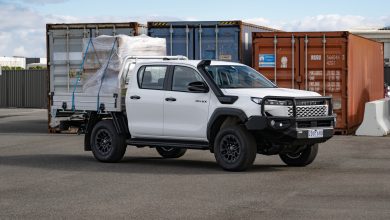
Toyota Australia has introduced its first-ever electric ute (EV), with the HiLux BEV. Positioned as a zero-tailpipe-emissions commercial vehicle, this model represents Toyota’s initial application of electric propulsion to a traditional body-on-frame architecture. However, the immediate question must be asked; is this a genuine mainstream contender for Australian driveways, or merely a highly specific compliance vehicle engineered exclusively for mining and government fleets?
The platform underwent more than two years of on-site testing with major mining companies, logging thousands of kilometres in site temperatures reaching 50 degrees Celsius with no recorded downtime. In Australia, it’s available exclusively in SR dual-cab-chassis and pickup, and SR5 dual-cab pickup configurations, with a universal twin-motor powertrain.
2026 Toyota HiLux BEV SR5: Specifications
Electrical: 2.59.2kWh battery, 2x e-motors
Output: 144kW / 475Nm
Gearbox: Single-speed auto
Drive type: All-wheel drive
Wheels: F & R: 17×7.5, 265/65
ANCAP: Five stars
Kerb weight: 2455kgPower-to-weight: 17.04:1 (kg:kW)
Official range: 315km (SR5), 245km (SR cab-chassis)
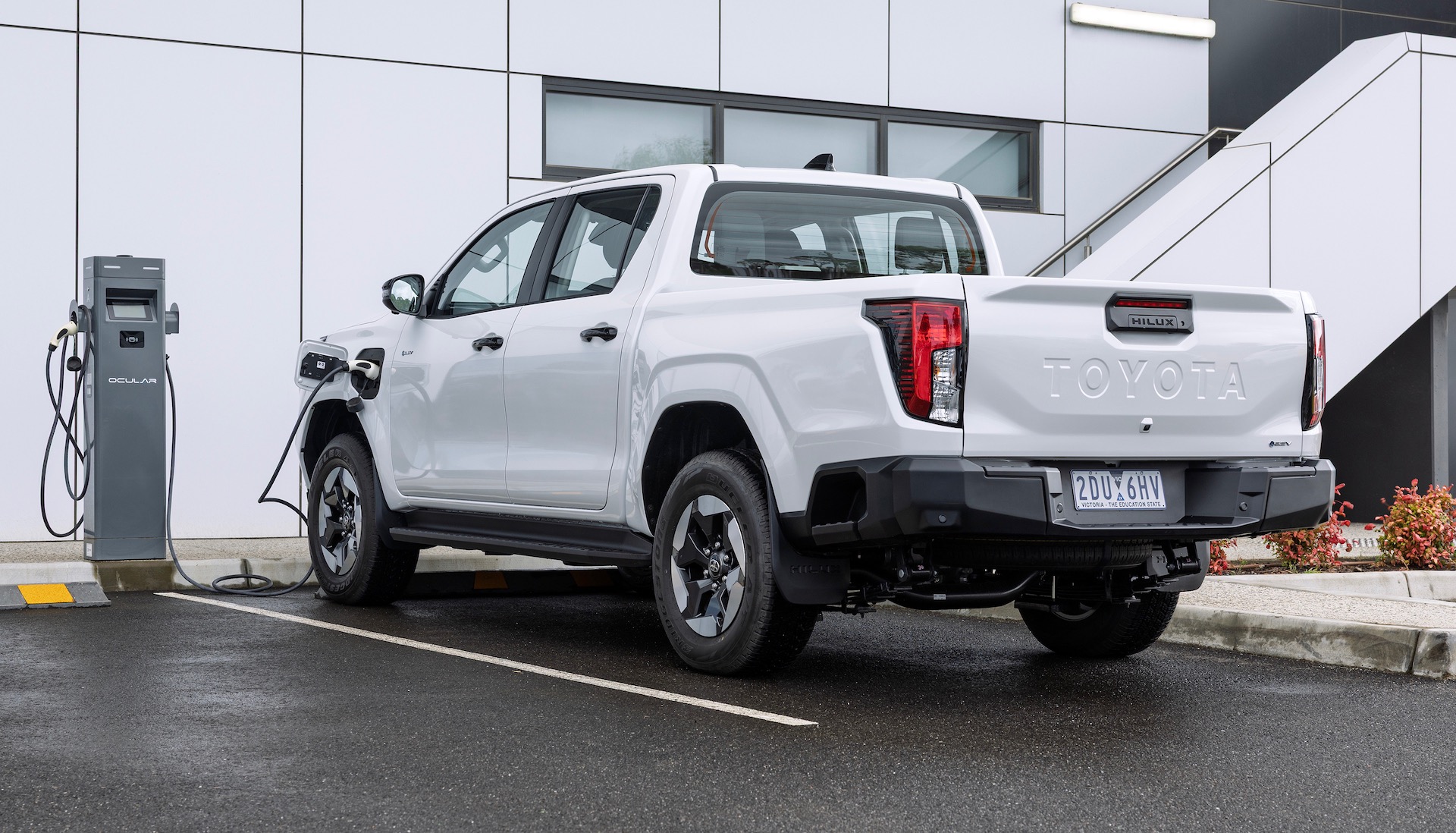
Max charging AC/DC: 10kW/150kW
0-100km/h: 8.74 seconds*
Starting price: $82,990*Figures as tested by Driving Enthusiast on the day. Manufacturers’ claims may be different
2026 Toyota HiLux BEV: How much does it cost?
The 2026 Toyota HiLux BEV range opens with the SR double cab-chassis, priced from $74,990. Moving up to the SR double-cab pickup commands $76,490, while the flagship SR5 dual-cab pickup asks $82,990 (all excluding on-roads). For reference, the top SR5 is a whopping $17,000 more than the regular diesel SR5 auotmatic. Reflecting its fleet-focused demographic, a premium paint upgrade is the only major option, available for $675 across a highly restricted palette of Glacier White, Frosted White, and Ash Slate.
Ownership coverage consists of the standard five-year, unlimited-kilometre Toyota Warranty Advantage. The high-voltage traction battery receives a baseline five-year warranty that can be extended up to 10 years, conditional on passing an annual Traction Battery Health Check. Additionally, Toyota provides an eight-year or 160,000km battery capacity warranty ensuring the pack retains at least 70 per cent of its original energy storage capability. For ongoing maintenance, servicing the HiLux BEV will cost owners roughly $2200 over five years, hindered by frustratingly short six-month scheduled intervals.
2026 Toyota HiLux BEV: Interior & packaging
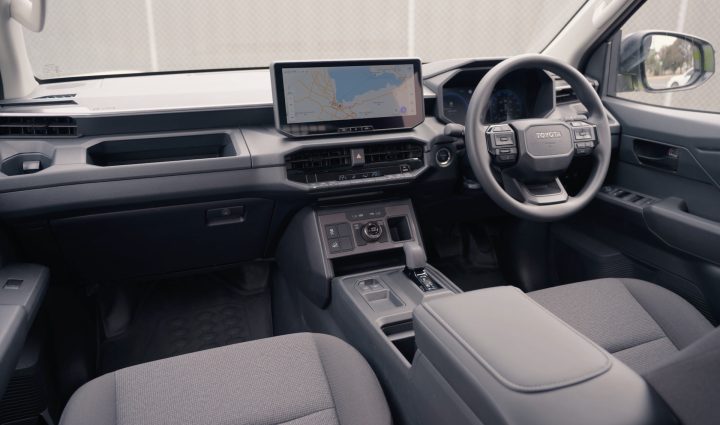
Standard features on the base SR grade include black fabric upholstery, a urethane steering wheel, a four-speaker stereo, manual air conditioning, and a vinyl floor covering. The higher-tier SR5 grade upgrades to carpet flooring, leather-accented upholstery with heat front seats, a heated leather steering wheel, an eight-way power-adjustable driver’s seat, an electro-chromatic rear-view mirror, wireless phone charger, and an eight-speaker audio system.
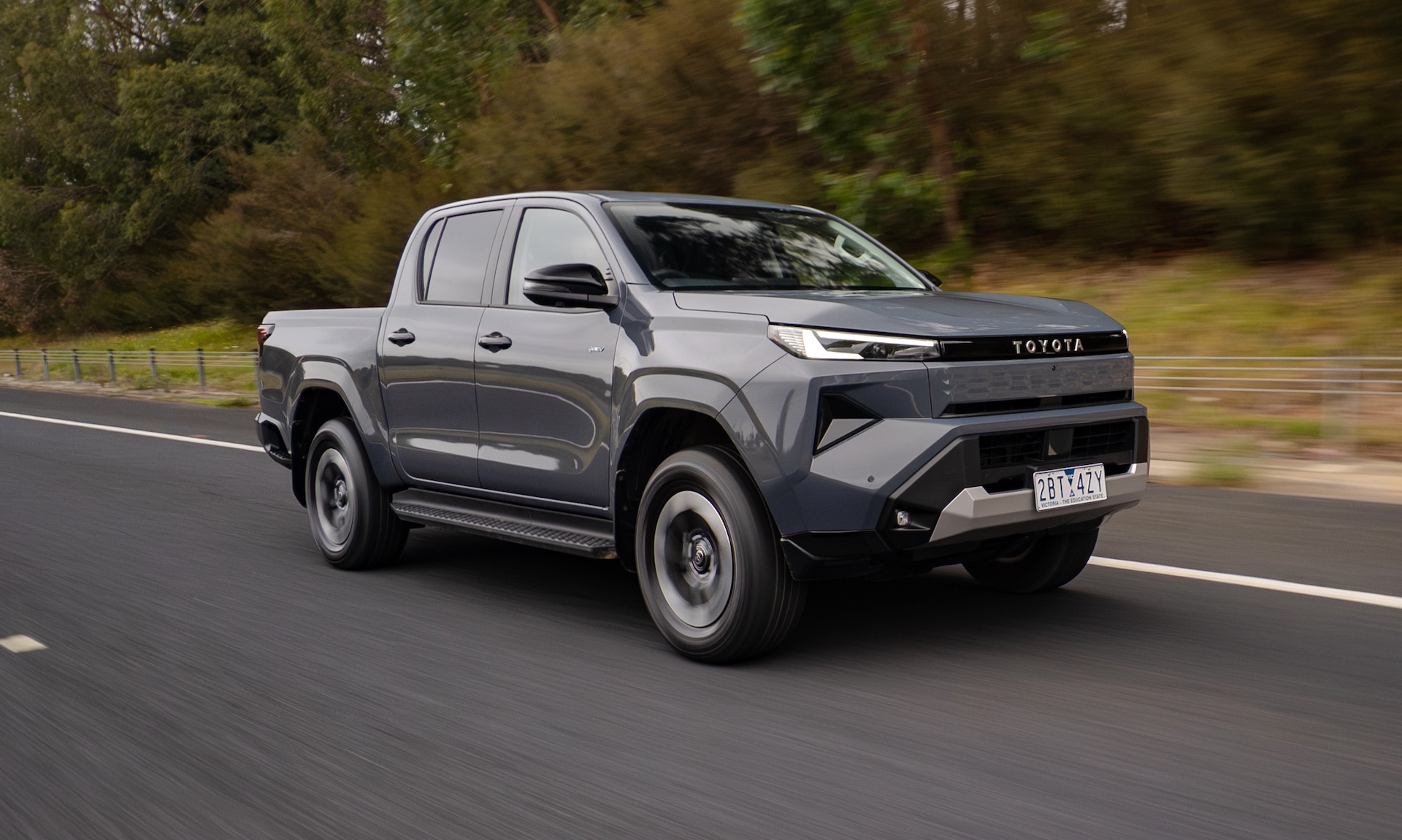
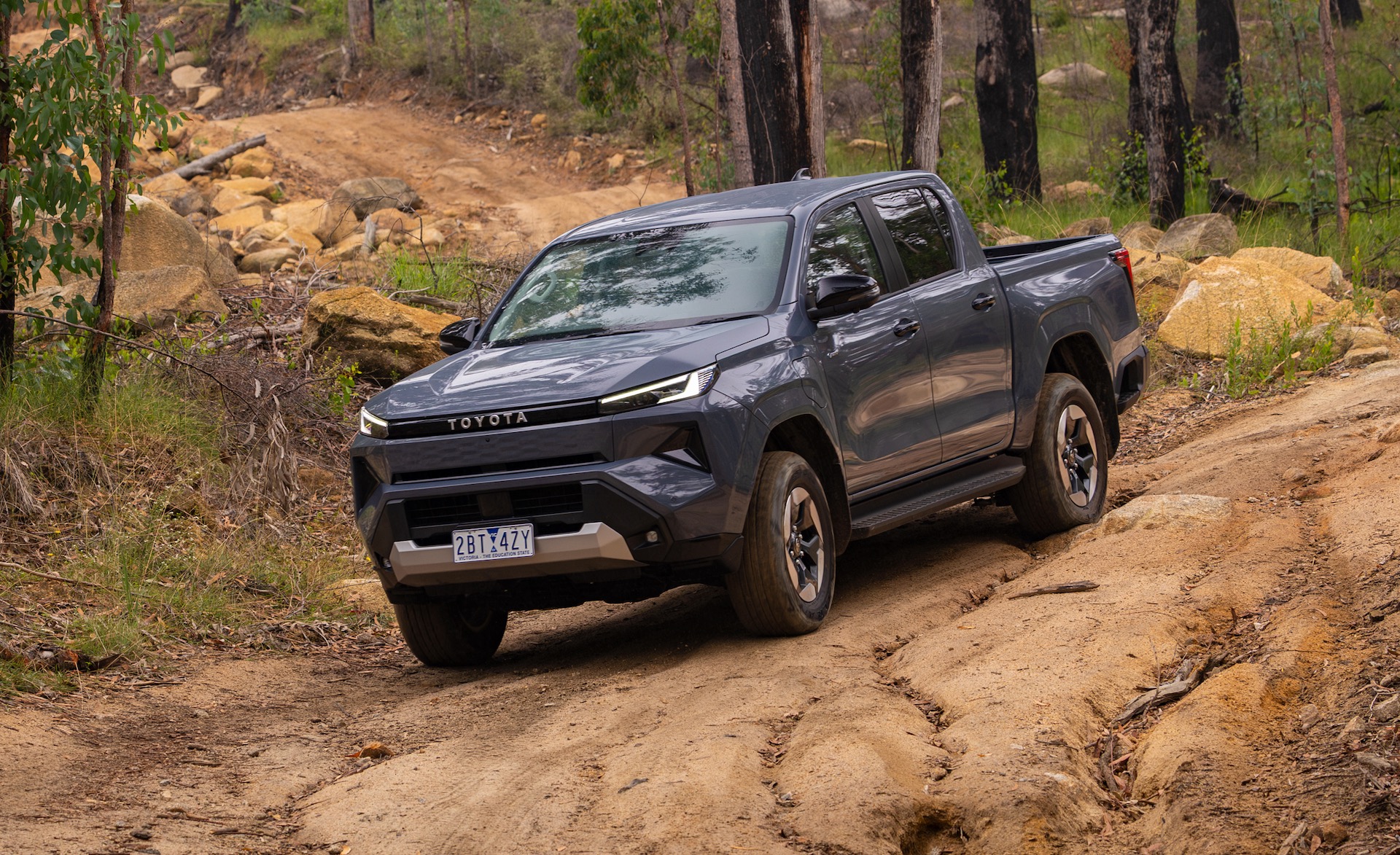
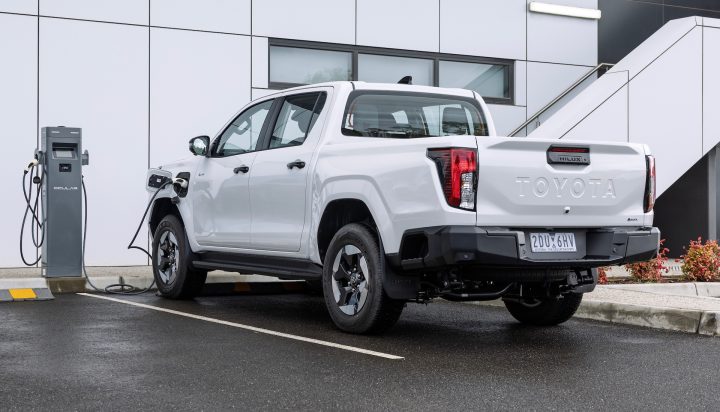
Dimensionally, the HiLux SR5 BEV measures 1855mm wide and rides on a 3085mm wheelbase, with a front track of 1530mm and a rear track of 1550mm. That means it is the same length as the diesel SR5, but 30mm narrower, and 20mm lower in roof height with the same wheelbase. Running ground clearance is rated at 218mm, delivering a 29-degree approach angle and a 25-degree departure angle for the SR5. Exterior visual delineators from internal combustion models are minimal, restricted to a solid front grille, unique aerodynamically-tuned 17-inch alloy wheels, and a dedicated charging flap positioned on the front passenger-side flank.

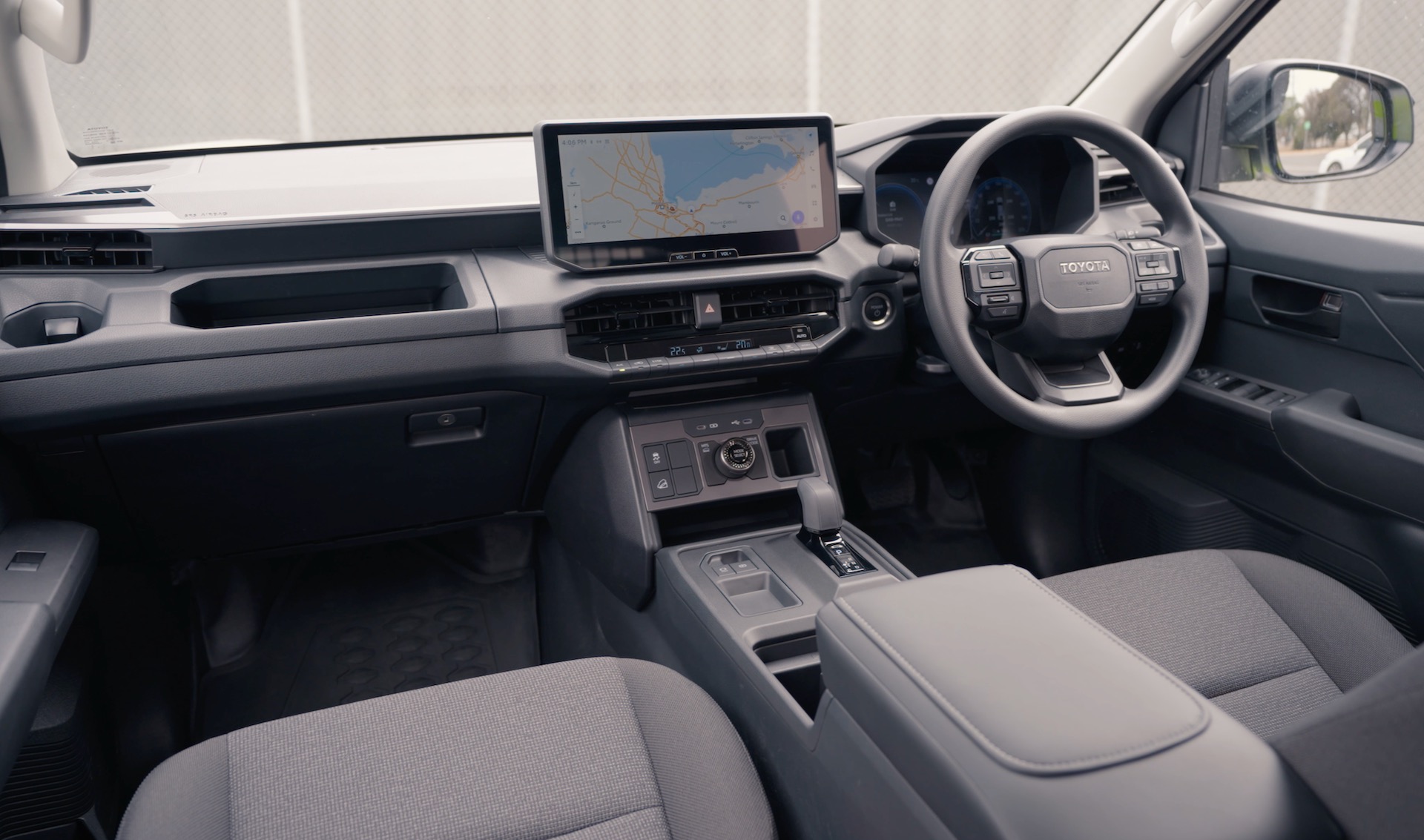
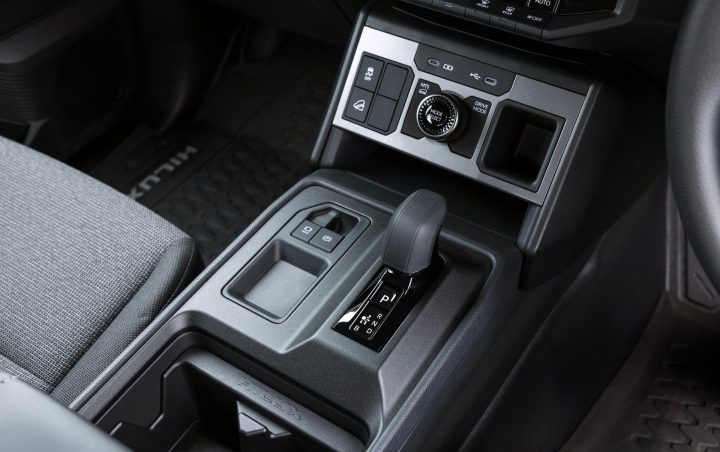
Inside, Toyota has introduced a bespoke 12.3-inch digital instrument cluster alongside a centrally-mounted 12.3-inch touch-screen display offering wireless Apple CarPlay and Android Auto, and embedded cloud-based satellite navigation. A Lexus-esque electronic shift-by-wire gear selector is positioned closer to the driver for improved ergonomics. The stubby shifter fits seamlessly into the otherwise traditional interior design, though its presence begs a glaring rhetorical question; why couldn’t Toyota have developed a proper plug-in hybrid powertrain around these components to take the fight directly to the BYD Shark?
Crucially for commercial operators, the central console box integrates a 220V/1500W inverter powering a standard three-pin AC outlet, allowing users to operate small tools or appliances directly from the traction battery.
Weight metrics vary by configuration. The SR cab-chassis carries a 2280kg kerb weight against a 3135kg Gross Vehicle Mass (GVM), resulting in an 855kg maximum payload capacity. The SR pickup registers a 2420kg kerb weight and 3145kg GVM, while the flagship SR5 pickup hits a 2455kg kerb weight and 3170kg GVM, restricting payload for the pickup models to a maximum of 725kg. All variants share a standard Gross Combination Mass (GCM) of 4670kg and are rated for a 2000kg braked and 750kg unbraked towing capacity. If you hook up a 2000kg trailer to the SR5, you’ll left with just 215kg of GCM for passengers and cargo.
Standard safety equipment across all grades includes eight SRS airbags, front and rear parking sensors, a surround-view monitor, downhill assist control, and a comprehensive active safety suite. This incorporates autonomous emergency braking, active cruise control with curve speed reduction, lane trace assist, emergency steering assist, blind-spot monitoring, safe exit assist, and rear cross-traffic alert with automatic braking support.

2026 Toyota HiLux BEV: Powertrain & handling
The HiLux BEV is built upon a reinforced steel ladder chassis, upgraded with additional crossmembers and thicker frame rails to enclose and protect the battery pack mounted between the rails. It’s a 296V, 80-cell lithium-ion pack with a total energy capacity of 59.2kWh. Thermal regulation is managed via a water-cooled heat pump system featuring a flexible sub-frame to withstand high levels of torsional twist during off-road articulation.
Propulsion is delivered by permanent magnet synchronous motors integrated directly into front and rear eAxle transaxles. The front motor generates peak outputs of 82.2kW of power and 205.5Nm of torque, while the larger rear motor produces 129.3kW and 268.6Nm. Combined, the system produces a maximum power output of 144kW, driving through a final drive ratio of 13.817:1. Maximum speed is electronically limited to 140km/h, and we timed 0-100km/h in 8.74 seconds with the Vbox – about 1.0 second quicker than the diesel SR5, according to our tests.
Official driving range under mandated ADR 81/02 laboratory tests on the combined cycle puts it at 315km for pickup variants and 245km for the SR cab-chassis. This theoretical range limit closely mirrors the dismal LDV eT60, but out on the road – and off it – the HiLux feels like a fundamentally more cohesive and thoroughly engineered vehicle. The platform’s credibility is backed by an intensive pilot program conducted alongside BHP at its Port Hedland mining operations in Western Australia, proving its capability in extreme real-world conditions.

Energy consumption figures register at 20.2kWh/100km for the pickup and 25.6kWh/100km for the cab-chassis. Replenishing the battery pack via its CCS2 port takes approximately 30 minutes to charge from 10 to 80 per cent when connected to a 150kW DC fast charger. Standard AC charging via the 10kW onboard charger requires 6.5 hours to achieve a complete state of charge.
Chassis dynamics are managed by an electronically controlled full-time AWD system that dynamically shuffles torque from a 100:0 to 0:100 front-to-rear distribution split. Off-road capability is supported by a six-mode Multi-Terrain Select system featuring dedicated Auto, Dirt, Sand, Mud, Mogul, and Rock/Snow calibrations.
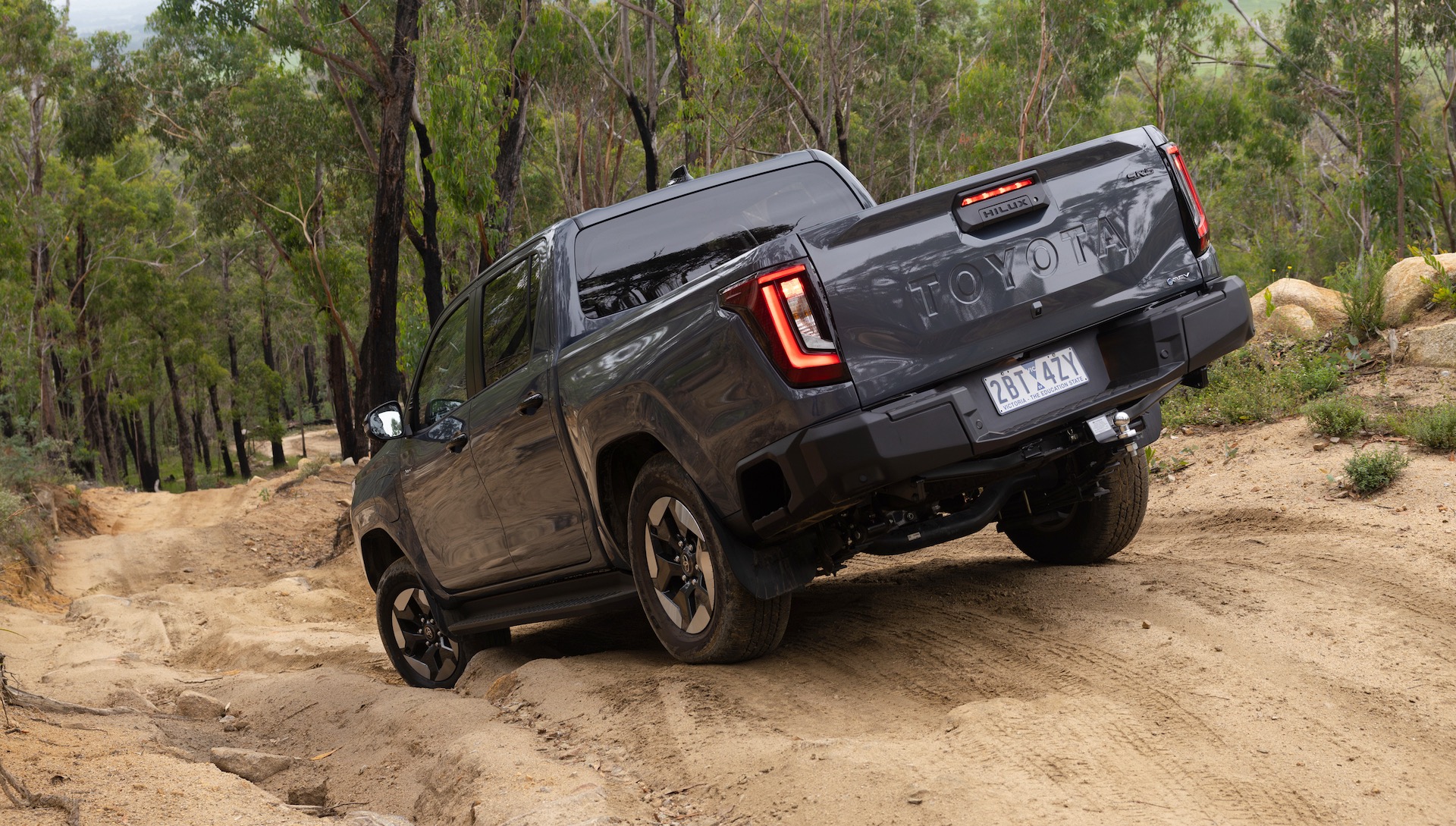
The front suspension architecture relies on an independent double-wishbone design with coil springs, utilising a thicker 34mm stabiliser bar, stiffer spring rates, revised damper rates, and updated bushings. At the back the configuration transitions to a De Dion rigid axle assembly paired with traditional leaf springs. By mounting the rear transaxle directly to the chassis, Toyota has reduced unsprung weight while utilising a rigid axle beam – constructed from lightweight high-strength pipe materials with forged carriers. These help to maintain ground clearance and component protection under heavy load.

Steering is executed via an electrically assisted rack-and-pinion setup requiring 3.39 turns lock-to-lock, with a 12.8-metre turning circle. Braking force combines regenerative deceleration with 338mm ventilated front discs clamped by fixed four-piston calipers, and 335mm ventilated rear discs with floating single-piston calipers.
Out on the road it feels like a tighter and firmer suspension tune, often jiggling and bouncing about on rough surfaces. It’s not as comfortable as the diesel SR5, for example. But the electronic power steering and the way the vehicle drives and handles feels pretty much the same. And the HiLux has never been about sportscar handling. Instead, concentrating on familiarity, diverse capability, and pleasant enough all-round dynamics.
2026 Toyota HiLux BEV: First impressions
Look, the 2026 Toyota HiLux BEV is a highly specialised tool designed for a very specific commercial brief. It succeeds in transplanting electric propulsion into a rugged, body-on-frame architecture, backed by extensive local durability testing that will reassure mining and government fleet operators who require zero-tailpipe-emissions transport on closed sites.
The clever De Dion rear suspension and auxiliary cabin power are genuine engineering highlights that add real-world utility. However, the severely compromised towing capacity, big price tag, and limited driving range mean it is fundamentally unsuited for private buyers or those expecting traditional diesel dual-cab versatility. It is a capable and reliable site vehicle, but a heavily compromised all-rounder.
2026 Toyota HiLux BEV: Video