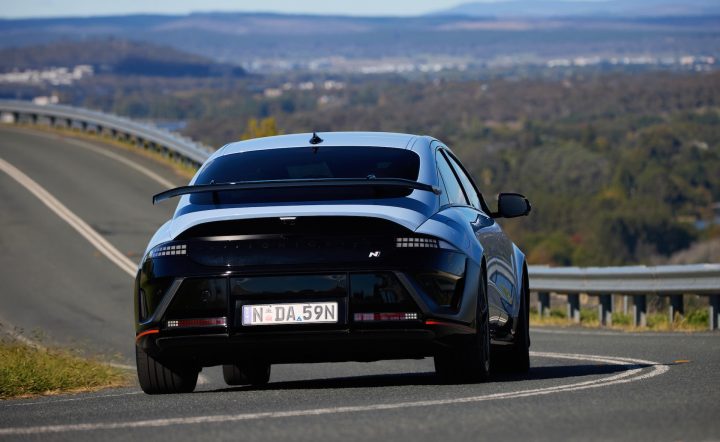
The Hyundai IONIQ 6 N represents another major step forward for Hyundai’s N division, but more importantly, it might finally be the electric performance car that properly connects with driving enthusiasts.
While many high-powered EVs rely almost entirely on neck-snapping 0-100km/h acceleration to impress, the IONIQ 6 N approaches performance from a much broader perspective; this focuses heavily on driver engagement and adjustability, and proper hardcore parts and track-honed development.
On paper, the numbers are outrageous as well, so there’s still that wow-factor element. With N Grin Boost activated, the dual-motor all-wheel drive system produces up to 478kW and 770Nm, enough for a claimed 0-100km/h sprint in just 3.2 seconds – the quickest Hyundai road car ever. Between the simulated gearshifts, configurable front-rear torque distribution, drift functions, adaptive chassis systems and surprisingly effective sound modes, this feels like an EV designed by people who actually understand car enthusiasts.
2026 Hyundai IONIQ 6 N: Specifications
Electrical: 84kWh battery, 2 x electric motors
Output: 448kW / 740Nm (478kW/770Nm N Boost mode)
Gearbox: Single-speed auto
Drive type: All-wheel drive (adjustable)
Wheels: F & R: 20×9.5, 275/35Kerb weight: 2201kg
Power-to-weight: 4.60:1 (kg:kW)
Official range (WLTP): 487km
Max charging AC/DC: 10.5kW/350kW
0-100km/h: 3.39 seconds*
Starting price: $115,000
*Figures as tested by Driving Enthusiast on the day. Manufacturers’ claims may be different
2026 Hyundai IONIQ 6 N: How much does it cost?
At $115,000 (excluding on-road costs), the Hyundai IONIQ 6 N certainly isn’t cheap. Although, Hyundai has cleverly matched the pricing of the related IONIQ 5 N, so you can decide based on your priorities in terms of practicality and design rather than purely on funds. On paper, that figure may seem ambitious for a Hyundai sedan, particularly in an increasingly crowded EV market filled with cheaper Chinese options; some of which offer similar 0-100 performance for much less.
However, the IONIQ 6 N probably deserves to be viewed less as a conventional EV and more as a genuine high-performance sports sedan. An Audi RS3 now starts from around $107,800 before on-road costs, while the last Audi RS4 Avant pushed beyond $165,000 locally. Given IONIQ 6’s level of actual performance hardware (crazy brakes, proper suspension and chassis bracing), and the level of driver engagement and capability it offers, the asking price suddenly feels far more understandable.

2026 Hyundai IONIQ 6 N: Interior & packaging
Inside, the IONIQ 6 N largely retains the clean and modern presentation of the regular IONIQ 6, although Hyundai’s N division has added enough bespoke details to give the cabin a sportier atmosphere. The N-specific steering wheel, complete with illuminated shortcut buttons and the red N Grin Boost switch, immediately sets the tone, while the blue-accented Alcantara and leather trim helps lift the ambience beyond the standard model.
The lightweight sports seats deserve particular praise. They provide strong lateral support during hard driving without becoming overly aggressive or uncomfortable during normal commuting duties. The low-mounted driving position also suits the car’s sporting intentions nicely, helping the driver feel integrated into the chassis rather than perched awkwardly above it.

Unlike some modern performance cars that bury essential functions deep inside touch-screens, Hyundai has wisely retained a separate climate control panel with physical buttons and toggles. It remains one of the more user-friendly interiors in the segment in our opinion, particularly while driving and trying to make quick adjustments without distraction.
Cabin quality is generally impressive throughout. Most surfaces feel solid and well assembled, with very little evidence of cost-cutting considering the price point – I notice the door trims feel a bit more premium over the IONIQ 5 N as well. There is still a slight sense of futuristic minimalism to the design, which may not appeal to buyers wanting the richness and warmth of some European rivals, but ergonomically it all works very well.

Practicality is a surprise. Despite the swooping roofline, rear-seat accommodation is genuinely spacious, with excellent legroom and enough headroom for most adults. Getting in does require some bending, but no need to take up yoga classes. You’ve got climate vents, charging options, and a flip-down arm rest and cup holders, covering the staple amenities.
Storage solutions are adequate rather than exceptional, with the boot opening being slightly compromised by the sedan body style. In many ways, the underlying platform feels like it would naturally suit a wagon body shape even better. Some buyers might also find the exterior styling slightly awkward from certain angles, although the aggressive N treatment certainly helps add visual presence over the regular IONIQ 6. Boot space is rated at 371L.

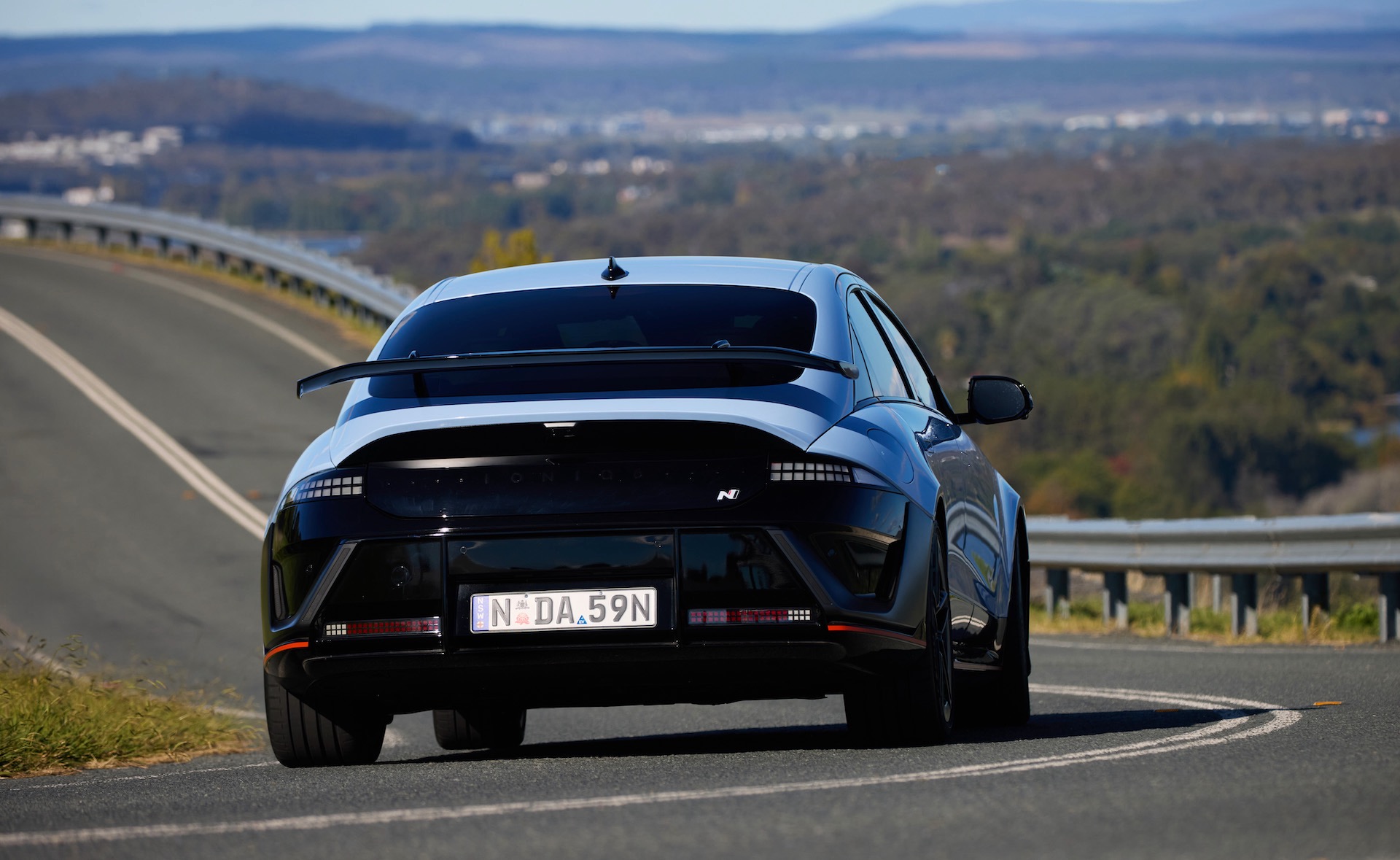
The optional carbon fibre aerodynamic package is also worth considering. Featuring a larger adjustable rear wing, side skirts, front splitter and rear diffuser, it transforms the visual attitude of the car while adding a genuine motorsport flavour.
Even the standard rear wing generates a meaningful 100kg of downforce at speed, while the optional race wing increases that to around 300kg. The carbon kit is around $25,000, but you can buy the sections separately if you only want the rear wing, for example.

2026 Hyundai IONIQ 6 N: Powertrain & handling
Powering the Hyundai IONIQ 6 N is an 84kWh battery pack paired with dual electric motors producing 448kW and 740Nm in normal operation, or up to 478kW and 770Nm during the 10-second N Grin Boost function. Hyundai claims 0-100km/h in 3.2 seconds using launch control, and we timed it in 3.39 seconds using a Vbox. It seems the on-board timer runs from the speedo rather than true speed (like most on-board timers), with a best result of 3.18 seconds shown on the dash.
The acceleration is violent, particularly from 60km/h onwards, yet unlike some EVs that simply overwhelm one sense with relentless thrust, the IONIQ 6 N manages to feel layered and narrative. A major reason for that is Hyundai’s N e-Shift system. Simulating close-ratio gearshifts (closer than the IONIQ 5 N tune), complete with drivetrain jolts, rev-matching downshifts and precise sound effects, it fundamentally mimics an i30 N in terms of theatrics and aural drama.
Rather than one continuous surge of torque, acceleration arrives in defined bursts, encouraging the driver to work through the virtual gears and engage with the car more actively. The accompanying pops, bangs and thuds could easily have felt artificial or childish, but the execution is remarkably polished. It genuinely adds involvement and rhythm to the driving experience in a way most EVs completely lack. Seriously, take one for a spin and see it in action yourself. You’ll be blown away, even if you don’t like EVs.

Normally, synthetic sound generators feel contrived, but Hyundai’s engineers have clearly obsessed over the calibration here. In the ‘Ignition’ mode especially, the sounds closely replicate the behaviour of a turbocharged dual-clutch performance car, right down to the subtle overrun crackles and aggressive upshift interruptions – and rev-limiter bashing if you don’t upshift. Combined with the N Ambient Shift Light system and the virtual gearbox logic, this is an immersive experience that makes many EV rivals feel comparatively sterile and boring.
Beneath the electronic theatre sits a comprehensive chassis package. Hyundai has reinforced the body structure with additional weld points, structural adhesives, rear bulkhead braces and strengthened suspension mounting areas over the regular model. Front and rear strut bracing further increases rigidity, helping give the car a tied-down and immediate feel during fast directional changes.

The suspension itself has also received substantial attention. The low roll-centre geometry, stroke-sensing adaptive dampers and integrated drive axles all work together to disguise the IONIQ 6 N’s considerable 2200kg weight remarkably well. Body control is excellent, particularly during high-speed cornering where the car feels stable and planted rather than nervous or overpowered. The dampers also manage to maintain a level of ride compliance considering the aggressive tyre and wheel package. This offers a taut and sporty feel in the default mode, but acceptable and comfortable enough for daily commuting. If you’re used to sporty cars, it’s a non-issue; this rides smoother and less harsh than many sports cars out at the moment.
Sitting underneath the pumped guards are bespoke 275-section Pirelli P Zero 5 tyres wrapped around forged 20-inch wheels, while an electronic limited-slip differential and configurable torque distribution system constantly shuffle power between the axles. Hyundai allows drivers to adjust front-to-rear torque bias across 11 stages, ranging from 95:5 front-biased for a hot hatch feel, or up to 5:95 rear biased for all-out drift action possibilities (see video below).

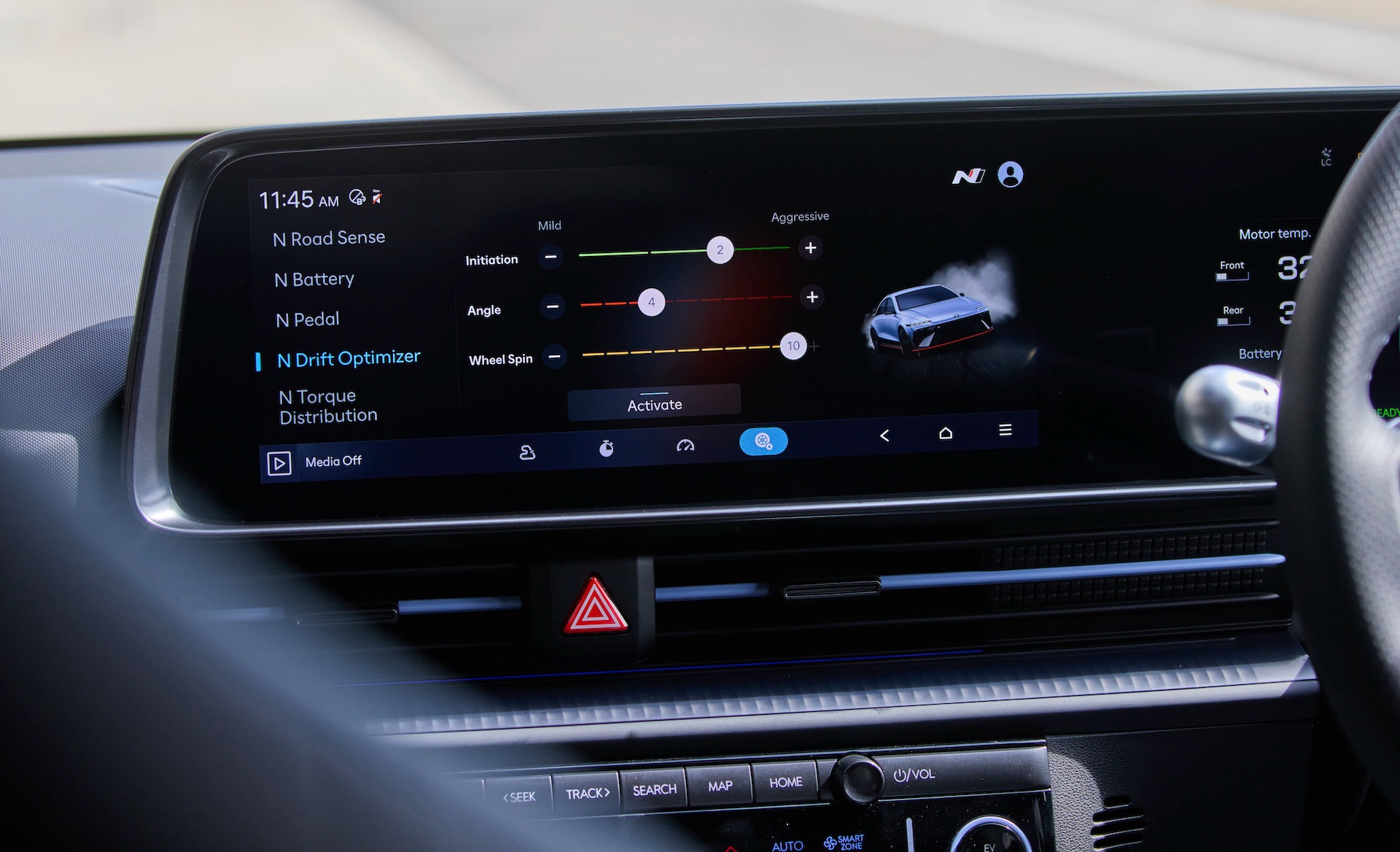
That adjustability is what really separates the IONIQ 6 N from many high-performance EVs. Most rivals feel locked into a single dynamic personality, whereas the Hyundai changes character depending on how it is configured. In one mode it feels planted, clinical and devastatingly fast from point to point; in another it becomes playful and adjustable. There’s even an N Drift Optimiser system.
As for braking, the package is equally serious. Massive 400mm floating front discs clamped by four-piston monoblock calipers are paired with 360mm rear rotors and an aggressive regenerative braking system capable of substantial energy recovery under deceleration. Importantly, the pedal calibration feels natural and consistent, avoiding the awkward transition between regenerative and friction braking that still affects some EVs. Given the vehicle’s weight and performance potential, the sheer stopping power inspires heaps of confidence. Including after repeated hot laps at Sydney Motorsport Park. This is not something many EVs can do.
Of course, physics can only be disguised to a certain extent. Push hard enough and the mass makes itself known, particularly during repeated heavy braking zones or rapid left-right transitions. Tyre wear is also likely to be significant, especially for owners regularly experimenting with rear-biased torque settings and drift modes. Consumable costs could realistically exceed those of some equivalent petrol-powered performance sedans.

2026 Hyundai IONIQ 6 N: First impressions
Even so, the broader achievement here is difficult to ignore. The IONIQ 6 N is not merely a fast electric car chasing headline acceleration figures. It feels like a genuinely engineered driver’s car, packed with thoughtful hardware and calibration work designed to keep enthusiasts interested beyond the first full-throttle launch. In many respects, it currently stands as the most engaging and entertaining EV on sale in our opinion. Easily.
Unfortunately, we get the feeling the sales numbers won’t be that impressive. But that’s okay because Hyundai is laying the foundations now so it can continue to build driver’s cars in the future if full-EV does take over. No other carmaker is preparing like this from a driving enthusiasts’ point of view. Not with evidence as convincing as this, anyway.
2026 Hyundai IONIQ 6 N: Video