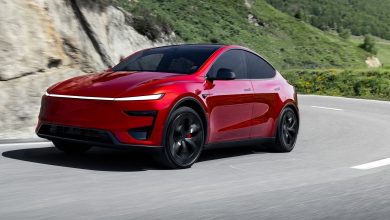
The Tesla Model Y is the best-selling EV in Australia, and in fact it was the best-selling car in the world in 2023. So then, the 2026 update for the Performance variant has some pretty big shoes to fill.
On the face of it, the new model builds on the popular foundation but presents meaningful improvements rather than headline-chasing reinvention. It’s still extremely powerful and quick, but promises to be more comfortable, smarter, and more practical than ever before. Let’s see if any of that is true.

2026 Tesla Model Y Performance: Specifications
Electrical: 85kWh battery
Output: 461kW / 741Nm
Gearbox: Single-speed auto
Drive type: All-wheel drive
Wheels: F: 21×9.5, 255/35 R: 21×10.5, 275/35
ANCAP: Five stars
Tare weight: 2033kg
Power-to-weight: 4.40:1 (kg:kW)
Max charging AC/DC: 11kW/250kW0-60km/h: 2.16 seconds*
0-100km/h: 3.81 seconds*
0-200km/h: 12.89 seconds*
60-110km/h: 2.19 seconds*
1/4 mile: 11.93 seconds at 193.1km/h*
Max acceleration: 1.145g*
100-0km/h braking: 36.85m in 2.84 seconds*
Max deceleration: -1.337g*
Starting price: $89,400
*Figures as tested by Driving Enthusiast on the day. Manufacturers’ claims may be different
2026 Tesla Model Y Performance: How much does it cost?
Prices start from $89,400 for the Performance (excluding on-road costs), which is quite a jump from the previous model which started from $82,900. And as more and more brands move into the EV space, the Model Y faces more competition than ever.
With more competition, you’ve also got more variety. But, mainly, more options and some are available at a lower price while offering more range and more power. Unlike the others though, Tesla has a party trick up its sleeve which could help it stand out; Full Self-Driving (FSD) technology. Yep, it’ll drive you to work or to pick up the kids, itself (as long as you sit in the driver’s seat and face the front).

2026 Tesla Model Y Performance: Interior & packaging
Tesla’s interior revisions are immediately noticeable. Build quality feels improved, with tighter panel gaps and a more solid impression throughout the cabin. Material choices have taken a step forward as well, particularly in the Performance variant, which gains carbon fibre trim across the dashboard and doors. It’s a welcome sense of occasion without being too gimmickry.
Practicality remains a strong suit. Storage solutions are clever and plentiful, with a proper centre console and divided buckets, cup holders, with pockets in the doors and even a flip-down arm rest in the back with more cup holders.

Rear seat space is generous, with a completely flat floor opening up legroom for the middle passenger. Comfort in the middle is slightly inferior to the outer seats, as usual in most vehicles, due to a firm backrest. But the power-adjustable reclining rear bench enhances flexibility. There’s also a touch-screen on the back of the main console for seperate climate controls.
As standard you get a full panoramic glass roof, which, in the hot Aussie summer, quickly turns into a giant radiator if left parked in the open. We measured up to 61°C surface temperature for the glass after a 30-minute shopping stint, and then it required around 20-30 minutes of blasting the air-con to cool the glass to the point where we could no longer feel the heat beaming from it. Not ideal. It should come with a sunshade as standard. It does come with double-glaze/acoustic windows however, which help with insulation.

Up on the dash, there are no buttons at all, just a 16-inch touch-screen (up from 15.4in in lesser variants). It’s a crisp and responsive system, with decent menu flow and logical layouts. However, with everything packed into the screen it can seem a bit crowded and overwhelming.
For example, the gear ‘shifter’, adjustments for the steering column, even the speed readout are all within the screen. This seems like a cheap way out for car brands, as fewer parts are needed compared with physical switchgear, while interior designers get the day off.

This minimalist layout will divide opinion, but you can’t argue about how clean and clutter-free the cabin is. That said, the steering wheel remains unusually small – almost comically so – and while it doesn’t hinder control, it does take some acclimatisation, particularly during spirited driving.
Boot space remains at the top of the class, with an impressive 938 litres expanding to 2022L with the rear seats folded and including the deep bucket under the floor. A secondary boot is found under the bonnet, giving you another 117L. It’s easy to see how the Model Y has become a family favourite.

2026 Tesla Model Y Performance: Powertrain & handling
Energy comes from an 85kWh battery that provides a WLTP-rated range of 580km. That’s at the pointy end in terms of range while the battery size is about average, which is good as it means less weight and shorter charging than bigger batteries.
The Performance offers 250kW DC fast-charging capability, or 11kW using an AC home charger, max. Those figures are only average, with some EVs offering 350kW or more and even 22kW with three-phase AC power. Being a Tesla though means you have access to more chargers as it can use both Tesla destination outlets and the regular public stations offered by various vendors.

With twin electric motors providing all-wheel drive, and up to 461kW (according to Redbook) or 343kW according to the Australian press release, it’s very powerful for a mid-size SUV. Again, there are more powerful options out there, such as the 550kW IM6 Performance – if outright power is what you want – but this sits nicely in the segment as one of the very quickest SUVs money can buy.
Acceleration is relentless, with instant torque delivery and excellent grip from the staggered-width Pirelli tyres, measuring 255/35 on the front and 275/35 on the back, on a 21-inch ‘Arachnid 2.0’ forged wheel. Tesla claims 0-100km/h in 3.5 seconds with a 1-foot rollout subtracted, and we timed it in 3.81 seconds with the Launch Mode, and 3.87 seconds without Launch Mode, with the battery at 79 per cent (we never subtract a rollout). We also timed 0-200km/h in 12.89 seconds, with the quarter mile crossed in 11.93 seconds at 193.1km/h. This is not mucking around.

Aside from the obvious excitement this acceleration brings to the driving experience, especially when pouncing between corners with immediate response from the AWD intelligence, this level of power also means overtaking and pulling out from a side-street is not a stress at all. Just nudge the throttle pedal and it’s off like a startled cat.
The adaptive suspension is clearly tuned with intent. In its sportier setting, it offers excellent body control and composure, bracing the car confidently through fast corners and giving the Model Y Performance genuine dynamic capability, even on ordinary Aussie bitumen. The trade-off is ride firmness, which may be too aggressive for some buyers. However, for those who value handling precision, the payoff is worth it – and it should be considering this is the ‘Performance’ variant, after all.

Efficiency is a standout. Even at highway speeds, the Model Y Performance feels impressively frugal for a vehicle with this level of power, reinforcing Tesla’s strength in battery optimisation and thermal management. Officially, it’s rated at 16.2kWh/100km, and we saw 17 during real-world testing.
As for the handling, the steering response is quick and direct, though still slightly nervous around centre – it’s getting close to being too touchy, and that tiny steering wheel doesn’t help. It suits enthusiastic driving but can feel hyperactive in day-to-day use. Obviously you can get used to it after extended use.

But the most impressive element is the grip and power distribution. We had this thing kicking at the back end, almost ready to oversteer when feeding in throttle at the apex or slightly before. It has proper sporty intensions if you want them. So, without an engine soundtrack to enjoy, at least you have fun handling and all of that acceleration to keep you entertained.
And then if you don’t want to drive at all, there’s the Full Self-Driving mode. This is available when the vehicle is in its default settings in terms of safety and modes, and it can drive you and your passengers to a destination prompted via the on-board sat-nav. It is very clever and essentially leads the class and industry. But since this is Driving Enthusiast, we’ll just leave it at that (demonstration in the video below).

2026 Tesla Model Y Performance: Key attractions/reasons to buy
- Comprehensive infotainment system does everything: New 16-inch system is clear and hugely capable.
- Proper performance handling: Excellent AWD intelligence that even has the ability to send more to the rear, giving a slight kick in oversteer.
- Full Self-Driving: Yep, it’ll drive itself to wherever you direct it. No other car on the market today can do the same.
- Performance: Seriously quick for a road-going vehicle, let alone a five-seat family-friendly SUV.
2026 Tesla Model Y Performance: Key considerations before you buy
- Sterile interior: While very clean and clutter-free, it doesn’t exactly celebrate the driver. Even the speedo is on the main touch-screen, shared with the rest of the cabin. No instrument cluster.
- Tiny steering wheel and touchy steering: It’s a bit sensitive and takes time to get used to.
- Firm ride: Suitable for a performance variant in our opinion, but something to note in case you’re expecting something else.
2026 Tesla Model Y Performance: Video


How does it rate against its rivals?
- Price
- Quality look & feel
- Interior tech
- Powertrain performance
- Ride & handling
- X-factor (does it stand out in its class?)
Final word
The updated Tesla Model Y Performance feels more mature without losing its edge. It remains brutally quick, but now pairs that performance with a noticeably improved interior, better ride control and strong real-world efficiency. The firm suspension, touchscreen-heavy interface and hyper-alert steering demand a degree of tolerance. But for buyers seeking a genuinely fast electric SUV that still works as a family car, the Model Y Performance continues to dominate this space.