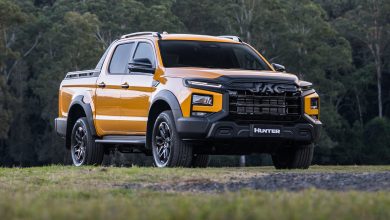
New to Australian showrooms, the 2025 JAC T9 joins an increasingly crowded dual-cab 4×4 ute market dominated by long-standing nameplates. This one comes with a different pitch; very competitive pricing and a level of interior refinement that might surprise some buyers.
Designed and built in China, the T9 isn’t pretending to be a heavy-duty workhorse like a Ranger Wildtrak or HiLux Rogue. But this is a new brand with a small yet growing dealer network. Is it going to be reliable and trustworthy for typical ute buyers? And what’s the resale like? Both complete unknowns for now and therefor a level of risk assessment is needed before proceeding.

2025 JAC T9 Haven: Specifications
Engine: 2.0-litre turbo-diesel four-cylinder
Output: 120kW@3600rpm / 410Nm@1500-2500rpm
Gearbox: Eight-speed auto
Drive type: RWD/4WD, dual range
Wheels: F & R: 18×8.0, 265/60
ANCAP: Five stars
Kerb weight: 2055kg
Power-to-weight: 17.12:1 (kg:kW)
Official consumption: 7.6L/100km
Our consumption: 9.1L/100km
Fuel tank/Fuel type: 76L/DieselPower efficiency: 15.78kW:L/100km
0-60km/h: 4.80 seconds*
0-100km/h: 11.12 seconds*
60-110km/h: 8.55 seconds*
1/4 mile: 17.86 seconds at 126.0km/h*
Max acceleration: 0.576g*
100-0km/h braking: 44.40m in 3.67 seconds*
Max deceleration: -1.030g*
Decibel at idle: 52*
Peak decibel at 60-100km/h: 83*
Starting price: $45,630
*Figures as tested by Driving Enthusiast on the day. Manufacturers’ claims may be different
2025 JAC T9 Haven: How much does it cost?
JAC is offering the T9 with drive-away pricing until the end of August. Two variants make up the range, with the Oasis and Haven priced from $39,990 and $43,990, drive-away (excludes WA). That makes it one of the cheapest 4×4 dual-cab utes on sale.
Regular pricing pushes things up a bit and away from that ‘cheapest in Australia’ league, with the Oasis starting from $42,662 and the Haven as tested here starting from $45,630, excluding on-road costs.
For reference, the GWM Cannon 2.4L Lux 4×4 dual-cab is $42,490 drive-away, and the SsangYong Musso ELX 4×4 dual-cab is $42,500 drive-away.

2025 JAC T9 Haven: Interior & packaging
Inside, the JAC T9 impresses with a clean and surprisingly premium layout. It isn’t immediately obvious this is built to a price, as the fit and finish feel far better than expected, with a mix of soft-touch materials on key touch points, including across the dash, and a simple, functional design.
Both the Oasis and Haven variants offer generous storage throughout the cabin, from console trays to a deep central bin, making it a practical space for tradies and families. You’ve also got cup and bottle holders front and back, and the Haven comes with a wireless phone charging pad on the console.

The seats are trimmed in durable materials, and in the Haven you get heated front seats which are a nice bonus for winter. Even rear seat space is respectable, with enough room for adults on long drives, complete with twin climate vents.
However, with a 3110mm wheelbase, the cabin is slightly shorter in length compared with some rivals. You don’t really notice it in terms of legroom but it does feel a bit awkward, almost like you’re sitting in the back of a space-cab but with legroom. Well, not that small but there is a pushed-forward feel in this.
Up front the 10.4-inch touch-screen looks impressive, though it’s not without its flaws. Navigating menus while driving can be tricky due to some inconsistent button placement and the lack of a persistent home shortcut; many of the pages take over the screen and remove the home button.

Swiping to the side unveils a conventional grid layout for all of the main apps, including the driver assistance menu which you will become very familiar with. An over-the-top driver monitoring camera, annoying speed warning that often gets it wrong, and lane ‘assistance’ features are all found here so you can turn them off.
JAC is boasting about its ANCAP result as the “safest ute” on sale. But, as we’ve seen in recent times, ANCAP is losing touch with what real safety is, and instead seems to be a tick-box committee these days; has the vehicle got this tech? Yes or no? That kind of thing. Doesn’t matter if the brakes are useless or if the vehicle can’t perform a basic swerve test without falling over. As long as it ticks the box. Anyway.

For example, the lane-keep assist failed to keep this test vehicle in the lane on multiple occasions during our tests (see video below), while other instances it yanked the steering wheel quite abruptly. If it can’t perform the task it sets out to achieve, how can that be rated ‘top marks’? We’ve seen this in many rival vehicles, so it’s not just the JAC that suffers from the same over-the-top, so-called safety systems.
The digital instrument cluster adds a touch of techy flair, albeit with limited display themes/options, and a 360-degree camera on the Haven bring welcome convenience. Visibility is excellent thanks to the upright shape and large windows, while the tray can accommodate a full-size Aussie pallet thanks to its 1590mm load width and 1520mm length.

2025 JAC T9 Haven: Powertrain & handling
Under the bonnet is a 2.0-litre turbo-diesel four-cylinder producing 120kW and 410Nm, paired with a ZF-sourced eight-speed automatic. While those outputs don’t sound impressive on paper – and it isn’t especially punchy in real-world driving – the T9’s pace is actually acceptable for most needs. Our testing saw 0–100km/h covered in 11.1 seconds, which is not far off many of the more powerful rivals. (Check our Vbox results database here and set the car type filter to ‘ute’.)
The engine does get a bit vocal under load and when cold, and it’s not the most refined unit around, rattling and clattering like it’s from 2003. But the transmission does a good job masking some of its shortcomings. In-gear heave is satisfactory, but off the line there is a noticeably long delay and highway overtaking performance is almost non-existent.

A side bonus here is fuel efficiency, with an official average consumption of 7.6L/100km placing it among the lowest in the class (only the Ford Ranger 2.0TTD is lower, at 7.2). Emissions is also creditable, at 202g/km. Again, among the lowest in the class. In the real world our week of testing averaged a respectable 9.1L/100km.
So, what about how it performs as a ute? Well, the braked towing capacity is 3200kg – slightly below the class standard of 3500kg – and with the modest outputs, we wouldn’t recommend long heavy towing as a regular task. It would be fine for light trailers and weekend getaways, especially on flat roads.

With a GVM of 3100kg and a kerb weight of 2055kg, it means you’ll have 725kg leftover for passengers and gear once you factor in the 320kg towball download. That’s really good for this class.
A gross combination mass of 5630kg also leaves a decent 375kg of leftover mass with a 3200kg trailer connected. But you do have to keep in mind this is only towing 3200kg. If you hook up a 3200kg trailer to rivals that have a 3500kg rating, you’ll have a spare 300kg available in the trailer for any extra cargo.

On the road, the T9 feels relatively composed. The suspension is a little bouncy at the front but comfortable, and the rear is jiggly and firm but nothing out of the ordinary for this class. Yes, there are more comfortable rivals, for sure. However, this isn’t unacceptable in our opinion. It’s worth noting this test vehicle is a production model; some media have been given early pre-production models in the recent past which may have behaved differently.
Interestingly, the steering feel is actually quite good. There is engagement here, which is unusual for this class. It’s not that the handling is like a Porsche 911, but there is a level of raw communication coming through the steering, so you always know what’s going on underneath.

This is probably due to its raw and aged chassis and basic steering setup, but who cares, the result is a good feel behind the wheel – not overly sharp and not too many turns lock-to-lock, and a reasonable turning circle of 12.4m.
Lastly, the off-road performance is great. It comes with low-range and a rear diff lock. And on our steep hill climb, the T9 demonstrated proper skill in terms of suspension flex and ability to provide drive and progression.
Sure, the Giti highway terrain tyres are not ideal, and the traction management isn’t the cleverest out there, often letting away too much wheelspin. But, with the diff lock engaged, it managed to climb both of our challenging lines with no issue. Some rivals have struggled here.

2025 JAC T9 Haven: Key attractions/reasons to buy
- Surprisingly refined interior: Soft-touch materials in important areas, and an overall neat and tidy layout, with 10.4-inch touch-screen and wireless phone charger as standard.
- Auto transmission: It’s a ZF eight-speed, offering smooth shifts and a good spread of ratios.
- Competitive pricing: Starting from just $39,990 drive-away (limited time offer), the T9 is one of the cheapest 4×4 dual-cab utes on sale.
- Warranty: 7-year/unlimited kilometre warranty and warranty loan vehicle program should provide peace of mind.
- Off road: A rear diff lock as standard and good suspension flex (even with its low 210mm ground clearance) results in decent off-road performance.
2025 JAC T9 Haven: Key considerations before you buy
- Engine: It’s noisy and offers low power and torque for this class.
- Towing: Limited to 3200kg, it falls below the main rivals. That engine will struggle towing a heavy load up long hills, too, compared with some rivals.
- Touch-screen layout: Some menus remove the home button and main menu items, with small almost hidden ‘back’ buttons tricky to catch while driving.
- Unknown brand: Means small dealer network, limited availability for servicing, likely smaller/slower parts supply chain, and resale isn’t going to be good… compared with most of the common rivals.
2025 JAC T9 Haven: Video


How does it rate against its rivals?
-
Price
-
Quality look & feel
-
Interior tech
-
Powertrain performance
-
Ride & handling
-
X-factor (does it stand out in its class?)
Final word
The JAC T9 Ute is a pleasant surprise in many ways. It blends a refined cabin with excellent value-for-money. It is one of the least powerful, but for buyers who don’t need to tow heavy loads and are looking for a comfortable, practical, and relatively capable dual-cab, it makes a strong case for itself. Our main concerns regard parts, service, network and availability, and resale.