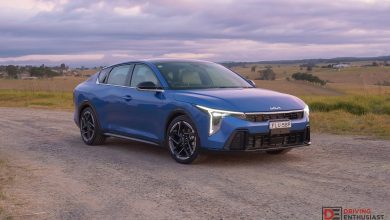
Not to toot our own horn, but Driving Enthusiast – and before that PerformanceDrive – was first to blow the cover off Kia’s Tasman project as far back as 2022, so there’s a certain satisfaction in finally driving the finished thing on home soil.
We also have some insight as to how it ended up looking the way it does. Early studio sketches and bucks showed something clean, almost futuristic, and distinctly un-HiLux. Then Kia focus-grouped the living bejeezus out of it.
Consequently, the front end has been toughened up for real ute buyers, with a grille that looks like Bane’s mask from Batman grafted on, along with other jarring elements such as the door handles and mirrors. The result is an incongruous design at odds with itself – a futuristic and forward-looking concept that self-consciously kowtowed to the traditional, ‘macho’ ute aesthetic of our most popular utes. You don’t need to go far to see the vitriol directed at it via social media, but, for what it’s worth, this writer is actually a big fan of Kia taking a divergent approach, instead of creating another HiLux/Ranger clone.
Call me cooked, but I see the Tasman a friendly alien that’s wandered in from another galaxy, eager to help move your payload, rather than another right-lane-hogging tough guy. It’s different, and it is a genuinely outstanding ute in most respects.

2026 Kia Tasman X-Line: Specifications
Engine: 2.2-litre turbo-diesel four-cylinder
Output: 154kW@3800rpm / 440Nm@1750-2750rpm
Gearbox: Eight-speed auto
Drive type: RWD/4WD
Wheels: F & R: 18×7.5, 265/60
ANCAP: Five stars
Tare weight: 2281kg
Power-to-weight: 14.52:1 (kg:kW)
Official consumption: 7.8L/100km
Our consumption: 8.4L/100km
Fuel tank/Fuel type: 80L/DieselPower efficiency: 19.74kW:L/100km
0-60km/h: 4.09 seconds*
0-100km/h: 9.31 seconds*
60-110km/h: 6.92 seconds*
1/4 mile: 16.73 seconds at 135.2km/h*
Max acceleration: 0.745g*
100-0km/h braking: 42.58m in 3.35 seconds*
Max deceleration: -1.339g*
Decibel at idle: 47*
Peak decibel at 60-100km/h: 77*
Starting price: $67,990
*Figures as tested by Driving Enthusiast on the day. Manufacturers’ claims may be different

2026 Kia Tasman X-Line: How much does it cost?
At the time of writing, the 2026 Kia Tasman X-Line 4×4 auto lists at $67,990 plus on-road costs, with most dealers advertising drive-away figures in the low-$70K bracket depending on the postcode. Kia’s national ‘X-Line Sports Pack’ offer has also seen periods where you can get into one for $67,990 drive-away in most states, including a soft tonneau, sports bar, side steps and metallic paint bundled in.
That puts it neatly between a Ranger Sport and Wildtrak, and up against lifestyle-leaning variants of the HiLux, D-Max, Triton, as well as increasingly abundant Chinese newcomers like BYD Shark 6 and GWM Cannon Alpha.
Tasman pricing in general is sharp. Dual-cab 4×4 models start in the high-$40Ks before on-roads, and every variant uses the same 2.2-litre diesel and eight-speed auto. X-Line sits one rung below the flagship Tasman X-Pro, sharing most of its cabin tech and safety gear but without the all-terrain rubber, lockable front diff or full off-road armour. As a result, it looks slightly less purposeful and cohesive but not as gawky or endearingly dopey as the Tasman S.
On the ownership side Kia backs the Tasman with its familiar seven-year/unlimited-kilometre warranty, seven years of capped-price servicing and roadside assist as long as you service it at Kia dealerships. Services are every 12 months or 15,000km; if you pre-pay, Kia dealers are quoting around $2800 for a five-year plan on a 4×4, with a seven-year plan pushing just over the $4000 mark.
That’s commensurate with a Ranger four-cylinder and slightly sharper than some of the newer Chinese rivals, especially once you factor in roadside coverage. Being a Kia with the proven 2.2-litre turbo-diesel, reliability is a pretty safe bet.

2026 Kia Tasman X-Line: Interior & packaging
Standard kit in X-Line is plentiful. You get 18-inch alloy wheels, LED headlights and taillights, keyless entry and start, dual-zone climate control, an integrated panoramic screen with twin 12.3-inch displays plus a climate panel, wireless Apple CarPlay/Android Auto, Kia Connect telematics, a 360-degree camera system with Ground View Monitor, trailer brake controller, remote smart parking assist (“summon”), and a fold-out centre console lid that becomes a work table like an F-150.
Inside, there’s also leather-look upholstery with a distinctive cross pattern, a power driver’s seat, heated front seats, rear seat recline, under-seat storage, and a 240V socket in the cabin. Plaudits are on order for the column-mounted gear selector, in place of the Tasman S‘s Rio-era T-bar.

The E-series Falcon-style climate pod and Honda Civic-style mesh climate vents add character. Handy cubby holes abound, with tie-down points on the passenger side, two phone receptacles with charging and sturdy, knurled metallic-feeling door handles that are satisfying to the touch finish it all of nicely. A selection of driving and off-road modes is also taken care of by knurled-feel buttons, with the dimensions of the ute etched onto the centre console. Ergonomically, the Tasman is a knockout and doesn’t feel like a workhorse at all and the driving position is perfect.
If you are going to use this as an actual ute, here are the important numbers. It’s 5410mm long, 1930mm wide and 1920mm tall, on a 3270mm wheelbase, so it’s properly big, with a tray capable of swallowing an Aussie pallet and over 1000kg of payload. There’s also an Australia outlet power socket in the sidewall. Towing capacity is is 3500kg (braked), gross combination mass (GCM) is 6200kg, with a 3250kg GVM. For reference, kerb weight is a hefty but class-standard 2223kg.

Off-roading credentials are sound as well; ground clearance is 224mm, wading depth is rated at 800mm, approach, departure and break-over are 28.9, 25 and 23.7 degrees, respectively. And the X-Line gets the cleaner front bumper bar similar to the X-Pro, and not the big ‘spoiler’ bit the hangs down on lesser variants.
Keeping with the theme of a more intelligent ute, there’s bio-plastics in the crash pad, seat fabrics woven from recycled PET and carpets made from recycled fibres, but it doesn’t feel like you’re sitting on milk bottles. The inlay of the phone chargers comprises the ubiquitous compacted, recycled material you see in pricier cars and looks a treat.
How safe is the 2026 Kia Tasman? ANCAP awarded the Jar-Jar Binks of the ute world a full five stars, with hearty scores of 85 per cent for adult occupant protection, 85 per cent for child occupant, 74 per cent for vulnerable road user, and 80 per cent for safety assist. But this score excludes the X-Line and X-Pro – these are untested. You can read the full ANCAP report here.

2026 Kia Tasman X-Line: Powertrain & handling
Despite modest outputs on paper from the 2.2-litre turbo-diesel four banger (154kW at 3800rpm and 440Nm from 1750-2750rpm), the engine always feels on song (with the turbo audibly spinning off idle), tied deftly to its eight-speed torque converter automatic. Unlike many 2.0-litre turbo or bi-turbo diesels in the segment, it never feels caught off guard. We timed 0-100km/h in a segment-leading 9.31 seconds.
Officially rated at 7.8L/100km and we achieved 8.4L, this is great for the segment and closer to the ADR82/01 figure than many rivals we’ve tested in the real world. Paddle shifters offer faithful up and down shifts, with the Tasman never feeling perturbed in a variety of conditions.

A big donk would go a long way to endearing it to some of the more ardent Aussie critics – we still love big hitting motors. Genesis’s now-defunct diesel inline-six (204kW at 3800rpm/588Nm at 1500-3000rpm) would’ve been sweet, but that engine is gone.
Ride and handling, though, are where the Australian-led development really shows. The Tasman uses double-wishbone front suspension and a live axle rear with leaf springs – de rigeur for the segment, but adds frequency-selective damping and hydraulic rebound stops.

On coarse-chip country roads the X-Line feels tied-down and composed, with a disciplined primary ride and far less pogoing from the leaf-spring rear than many rivals when the tray is empty. Over freeway corrugations there is a slight oscillation and jiggle – you’re aware that it’s a big ladder-frame ute on leafs – but it never feels loose or floaty.
There are instances where you can get caught out with the weight transfer, however. If you’re not paying attention, correction around high speed sweeping bends may be in order but it quickly settles back into composure. This is a consequence of the almost 2300kg kerb weight. Just remember to drive it like a ute, not a hot hatch.
Terrain modes (Mud, Sand, Snow, Rock) and X-Trek low-speed cruise control make light work of fire trails and rutted access roads. There is a ‘4A’ mode as well, which means you can drive this on dry tarmac with all-wheel drive grip – not many rivals offer this.

2026 Kia Tasman X-Line: Key attractions/reasons to buy
- Best-in-class cabin space and clever storage: Huge second row with reclining backrest, under-seat storage and that brilliant fold-out centre console table make it an easy family hauler and mobile office.
- Polished ride and refinement for a ladder-frame ute: Aussie-tuned suspension, frequency-selective dampers and good sound insulation give it a calm, composed feel on long trips.
- Genuinely useful tech and features: Ground View Monitor, 360-degree cameras, integrated trailer brake controller and remote smart parking assist are the sort of toys you actually end up using.
2026 Kia Tasman X-Line: Key considerations before you buy
- Styling feels at odds with itself: The “Bane mask” front and tough-guy addenda sit awkwardly on what is otherwise a friendly, approachable design.
- Engine trails key rivals for grunt: The 2.2-litre four-cylinder is smooth and efficient, but lacks the effortless surge of V6 competitors and feels stretched when towing at the limit.
- Safety and spec caveats at this price: X-Line is priced against premium lifestyle utes yet misses ventilated seats and a branded audio system, and remains technically unrated by ANCAP even though related Tasman variants carry five stars.
2026 Kia Tasman X-Line: Video


How does it rate against its rivals?
- Price
- Quality look & feel
- Interior tech
- Powertrain performance
- Ride & handling
- X factor (does it stand out in its class?)
Final word
All-in-all, the Tasman has a heart of gold and a very impressive breadth of capability which deserves to be doing better in the sales charts than it is. The combination of towing, payload, off-road prowess and arguably the nicest interior in its class make this one ute we have no hesitation recommending. If you need macho styling as an extension of your ego, perhaps the styling will remain an insurmountable obstacle. For everyone else, this is an intelligent choice.