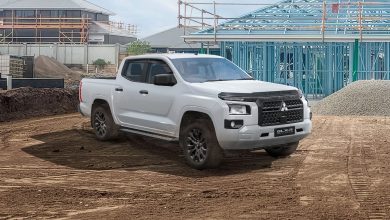
The 2026 Mitsubishi Triton GLX-R could represent the sweet spot in the new-generation Triton lineup, striking a balance between capability, comfort, and value.
With its refreshed design, upgraded powertrain, and enhanced safety features, the Triton now competes strongly in Australia’s highly competitive ute market. But it is more expensive than before and you could argue it has become a more complicated and complex machine, potentially losing some of its true-blue workhorse appeal.

2026 Mitsubishi Triton GLX-R: Specifications
Engine: 2.4-litre twin-turbo four-cylinder
Output: 150kW@3500rpm / 470Nm@1500-2750rpm
Gearbox: Six-speed auto
Drive type: RWD/4WD, dual range
Wheels: F & R: 18×7.5, 265/60
ANCAP: Five stars
Kerb weight: 2120kg
Power-to-weight: 14.13:1 (kg:kW)
Official consumption: 7.7L/100km
Our consumption: 9.0L/100km
Fuel tank/Fuel type: 75L/DieselPower efficiency: 19.48kW:L/100km
0-60km/h: 4.21 seconds*
0-100km/h: 9.49 seconds*
60-110km/h: 7.10 seconds*
1/4 mile: 16.88 seconds at 129.3km/h*
Max acceleration: 0.716g*
100-0km/h braking: 41.72m in 3.61 seconds*
Max deceleration: -1.255g*
Decibel at idle: 50*
Peak decibel at 60-100km/h: 83*
Starting price: $57,240
*Figures as tested by Driving Enthusiast on the day. Manufacturers’ claims may be different
2026 Mitsubishi Triton GLX-R: How much does it cost?
The GLX-R starts from $57,240 (excluding on-roads), placing it among the better-value options in this class, for an established brand. Yes, you can pick up a BYD Shark 6 for similar money but a Shark can’t tow 3500kg and isn’t as good off road compared with this. You could also grab a GWM Cannon for less.
But, with a Triton you’re also paying for an established local parts supply and warranty network with a major distribution centre in Melbourne). Chances are, if something breaks on this and the same thing breaks on a Cannon or Shark, you’ll have the Triton fixed and back on the road quicker than those. Generally speaking, anyway.
So instead, its closest rivals would have to be the Isuzu D-Max X-Rider and Nissan Navara ST-X (outgoing model). The D-Max X-Rider starts from $59,500 and the Navara starts from $59,323. Very soon the Navara will switch over to the new generation, which is a Triton underneath. But it could be worth looking into to see if the price and/or features stack up evenly.

2026 Mitsubishi Triton GLX-R: Interior & packaging
The GLX-R cabin feels modern and functional. Some soft-touch surfaces elevate the ambience, while single-zone climate control provides basic cabin comfort. The 9.0-inch infotainment display is also pretty basic in terms of graphics and depth, but it does come with wireless Android Auto and Apple CarPlay.
Most of the switchgear has been designed with practicality as a primary focus, so the buttons are large and the dials and knobs operate in logical ways. This is one of those vehicles that only requires a quick glance on the controls before you’re reaching for them without even taking your eyes off the road.

Cabin ambience and refinement is clearly up another level over the predecessor, but it’s not the most premium in terms of look and feel. If you’re after that sort of thing then perhaps check out some of the newcomers from China. They do very well in terms of modernised interiors and technology. This is about function and durability.
Passenger space has been improved over the previous model, with more shoulder room and legroom than before. Although, it is still on the narrow end of the class standards. But that’s perhaps due to rivals getting bigger and bigger rather than this being inadequate.

As for the weights and capacities, Mitsubishi Australia offers a lower payload option at no extra cost on the GLX, GLX+, GLX-R, GLS and GSR, bringing them under the 1000kg mark to make them eligible for novated lease customers. The regular payload is 1080kg for the GLX-R and it can drop to just under 1000kg.
All Tritons now offer a 3500kg braked towing capacity, with the GVM stamped at 3200kg (or 3075kg for the lower payload option) on the GLX-R. Its GCM rating is 6250kg. So, taking the GVM, subtract the 2120kg kerb weight, then 350kg for the towball download at max towing, and you’re left with 730kg.

However, you’ll run into the GCM before that, with 630kg leftover after subtracting the kerb weight and 3500kg towing max from the GCM. A very high figure for this class. It means you can legally tow 3500kg and still have 630kg leftover for passengers and cargo – plenty enough for most scenarios.
Going for the GLX-R also gets you various black trimmings on the outside to give it that must-have sporty look, including the side mirrors and window surrounds, door handles, and a sports bar in the back. It also comes with black-painted 18-inch alloy wheels wearing 265/60 Maxxis all-terrain tyres.

2026 Mitsubishi Triton GLX-R: Powertrain & handling
At the heart of the Triton GLX-R is Mitsubishi’s new (heavily updated) 2.4-litre twin-turbo diesel engine. Generating 150kW and 470Nm, it’s a notable step up from its predecessor. The twin-stage turbocharging ensures responsive performance at low revs while maintaining a strong pull at higher speeds, with peak torque spread across 1500-2750rpm, and peak power reached at 3500rpm.
Not that these utes are designed for it as a primary development pillar, we timed 0-100km/h in a very respectable (for a diesel ute) 9.49 seconds. It has no trouble getting up to highways speeds and doesn’t feel too strained when you’re in a bit of a rush. Just don’t expect a whole heap in the top end. Overtaking at highway speeds (from 100km/h) is more of a challenge compared with, say, a typical large SUV. However, not many rivals do better.

The output figures are pretty much at the top of the class for a four-cylinder diesel, albeit with torque slightly down on the 500Nm standard. It’s paired with a six-speed automatic transmission, and the GLX-R gets Mitsubishi’s Super Select 4WD II system, offering 2H, 4H, 4HLc and 4LLc (locked centre), as well as a rear diff lock for optimal traction
Off road, the Triton has always been one of the best performers for an out-of-the-box package in this space. And this is no different. Sure, some really chunky all-terrain tyres would help, but even on the standard stuff this tackled our hill climb tests with ease. The drivetrain with the diffs locked is almost unstoppable. If you encounter tracks that this can’t conquer, then perhaps you should double-check the track actually leads somewhere.

Ground clearance is measured at 228mm, which doesn’t look that good on paper. In the real world, though, it doesn’t seem to be an issue. You’ve also got an impressive 30.4-degree approach angle, and 23.4-degree break-over angle. A departure angle of 22.8 degrees isn’t as well positioned among its rivals, but still workable on serious terrain. Hill descent control and terrain control further enhance its off-road capability.
On the road, the suspension leans towards comfort with its standard-duty setup. The GLX-R remains composed on country roads, if a little bit jiggly like almost all rivals, making it a versatile option for adventurers or fleet drivers. The steering is nice as well, and body lean is kept to a minimum. Although, the front end’s resistance to roll and pitch is a shade weaker than some.
Lastly, and most annoyingly, it’s the safety assist systems. Like in plenty of modern vehicles, the driver attention monitor often sends off false-alarms, so you switch it off. And you have to do it every time you jump in. Likewise, the lane-keeping assist technology can be a bit premature in predicting accidents. So you end up turning it off as well. The main thing is this is nothing new; most competitors have similarly-frustrating tech.

2026 Mitsubishi Triton GLX-R: Key attractions/reasons to buy
- Refined powertrain: The new bi-turbo diesel is powerful and smooth, while offering one of the lowest official average consumption rates in this class: 7.7L/100km.
- Modern features: From wireless smartphone integration to multiple charge ports, the GLX-R caters to tech-savvy buyers without becoming overly complex or tech-reliant.
- Practical design: The larger dimensions of the latest model improve usability for work, family duties and recreation. It’s more comfortable inside and nicer to live with.
- Excellent towing and capacities: You’ll find the GLX-R offers one of the best GVM and GCM leftover capacities in this field. You can tow 3500kg and still have weight left for the family or for something very heavy in the tray.
- Peace of mind: Its 10-year warranty (when serviced at Mitsubishi) has to be noted as a serious drawcard. That’s 10 years of worry-free ownership. Generally speaking.

2026 Mitsubishi Triton GLX-R: Key considerations before you buy
- Driver assist safety tech: Yes, some of it is really annoying. But there’s no getting away from it by choosing a rival. They all suffer, only in varying severities.
- Design: It’s a subjective thing but we’re not a big fan of the latest design theme. It doesn’t look as tough as some rivals in our opinion. And toughness – even if only cosmetic – is very important in this segment.
- Slightly down on torque: It’s not a big deal but if you’re comparing specs on paper, the Triton offers 470Nm while some better-selling rivals offer 500Nm.
2026 Mitsubishi Triton GLX-R: Video


How does it rate against its rivals?
- Price
- Quality look & feel
- Interior tech
- Powertrain performance
- Ride & handling
- X-factor (does it stand out in its class?)
Final word
While not as feature-packed as the top-spec GSR, the GLX-R’s balanced approach makes it an excellent choice for families, tradies, and adventure seekers as it isn’t ridiculously expensive but still does everything the GSR can do off road. Though, we’d love to see a hardcore off-road variant to really maximise that awesome Super Select 4WD system.