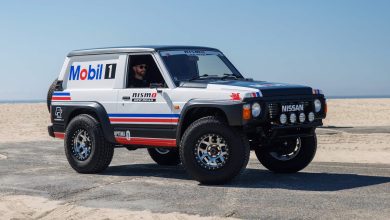
Australia has long had a love affair with the Nissan Patrol. For decades it has been the weapon of choice for families, farmers, grey nomads, and serious off-road adventurers alike. These days, its combination of a naturally aspirated V8 engine, cavernous interior, and tough, ladder-frame chassis keep it desirable in a market increasingly dominated by turbo-diesels and hybrids. For the 2025 update, Nissan has given the Y62 a much-needed update for the dashboard and on-board technology.
Here we’re sampling the Warrior variant, which is a locally-engineered package by Australian company, Premcar. The formula isn’t complicated; take the standard Patrol Ti, give it more clearance, wider tracks, suspension tuned for local conditions, tougher exterior detailing, and a bit more visual attitude. The result is a large SUV that not only looks the part, but backs it up with genuine capability where it matters most – on rough country tracks, sand dunes, or towing big loads across long stretches of Aussie highway. But while the Patrol Warrior has serious credentials, it also comes with compromises. Let’s break it down with a top 5 pros and cons.

2025 Nissan Patrol Warrior: Pros
1. Thunderous V8 with proven reliability:
The Patrol Warrior continues to use Nissan’s 5.6-litre naturally-aspirated petrol V8, producing 298kW and 560Nm. It’s a motor that feels unapologetically old-school – big capacity, smooth power delivery, and no turbos or hybrid systems in sight. While many brands have downsized to six-cylinders or hybrids, this V8 remains a rare beast in 2026, and for some buyers, it’s a huge part of the Patrol’s appeal.
The soundtrack is equally satisfying. There’s a deep, muscular rumble under throttle that feels fitting for a vehicle of this size and stature. More importantly, the engine’s linear power curve makes towing effortless. Whether you’re hauling a horse float, caravan, or large boat, the Patrol Warrior feels unstrained; and that peace of mind is valuable for long-distance touring. The proven reliability of this unit – which Nissan tested extensively in Australia’s harsh climate – also means you’re buying into a powertrain with a solid track record.
Additionally, it’s all backed up by a 5-year, unlimited kilometre warranty, or a remarkable 10 years and 300,000km (whichever occurs first) if you service it through Nissan.

2. Serious off-road capability
Premcar’s upgrades aren’t just cosmetic. The Warrior package lifts ground clearance from 272mm to 323mm, increases the track width from 1695mm to 1735mm, and incorporates redesigned springs and dampers tuned specifically for Australian conditions. The result is a Patrol that feels at home tackling rutted tracks, river crossings, and soft sand, while also offering better (in our view) on-road dynamics.
Approach and departure angles also jump from 34.4 to 40 degrees and 26.3 to 23.3 degrees (due to towbar), respectively. More underbody protection is added, and Yokohama Geolandar all‑terrain tyres (fitted to 18-inch alloys) provide better performance off road. Combine this with the Patrol’s existing low-range transfer case, locking rear differential, and a chassis built on toughness, you have a large SUV built for the challenge of the Cape, Simpson Desert, or Kimberley.

3. Towing and GVM
With a braked towing rating of 3500kg, the Patrol is among the most capable tow vehicles you can buy without stepping into American full-size pickup trucks. The suspension tuning and wide stance mean stability is excellent, even when hauling close to the limit. The towbar setup has a restructured cross-member, tongue, and harness to allow the Warrior to carry a full-size spare wheel under the vehicle. It also scores two recovery points to aid you or your mates out of trouble.
The naturally aspirated V8 provides predictable performance that doesn’t fluctuate like turbocharged engines can under heavy load, or in hot conditions. In practice, this makes the Patrol Warrior a favourite among those towing heavy caravans on long trips. It might not sip fuel like a diesel, but its smooth power delivery and relaxed highway cruising make life easier when covering thousands of kilometres with a trailer behind you.
4. Spacious and comfortable for all
Step inside and you’re greeted with a cabin that’s more about space and comfort than the latest tech gimmicks. Three rows of seats mean the Patrol Warrior can legitimately carry eight adults, and the wide proportions give passengers a sense of roominess that smaller SUVs simply can’t match.
The leather-appointed seating, Alcantara and suede door trim, wide door openings, and commanding driving position are all strengths. The second row offers generous legroom, and even the third row is usable for adults. Long-distance comfort is excellent, thanks to supportive seats and good noise suppression at highway speeds. While the interior design may look dated compared with luxury rivals, it’s practical and built to withstand years of family abuse.

5. Australian-made… sort of
Unlike many imports that arrive in Australia unchanged, the Patrol Warrior is engineered locally by Premcar. That means the suspension, tyres, and tuning have been tested across the kinds of roads and conditions that Australians actually drive on – from corrugated outback highways to suburban speed humps.
This local input shows. The Warrior feels more composed over rough country terrain than the standard Patrol, and the balance between off-road toughness and on-road comfort is better judged. Add in the tougher exterior styling – wider guards, Warrior badging, black accents – and the Patrol Warrior looks every bit the Aussie adventure machine.

2025 Nissan Patrol Warrior: Cons
1. Fuel consumption
There’s no avoiding it. The Patrol Warrior is thirsty. The official combined figure is 14.4L/100km, and during our week of mixed highway and city driving, our average was even higher, at 15.6L/100km. Towing or serious off-road work pushes that figure even higher.
In an era where hybrids and diesels dominate the touring scene, the Patrol Warrior’s appetite for fuel is its biggest drawback. Long trips require careful /planning budgeting, and the high cost of petrol makes ownership an expensive cost in general.
2. Ageing platform and tech
Step into the Patrol Warrior and you’re reminded that the basic interior architecture hasn’t significantly changed in over a decade. This is the tail end of a generation as a new generation Patrol is imminent. The dashboard design still looks old, but the infotainment system has been updated. Wireless Apple CarPlay and Android Auto are included, and the centre touch-screen is a decent 12.3 inches – the screen resolution is a tad behind compared with modern rivals.
Safety tech is another area where the Patrol lags. While it offers essentials like adaptive cruise control, blind-spot monitoring, an off-road monitor, 360-degree cameras with object detection, and lane-departure warning, the suite isn’t as comprehensive or advanced as you’ll find in newer SUVs. For some, that might be a blessing.

3. Being massive is not always practical
The Patrol Warrior’s sheer size is a double-edged sword. On the open road and in the bush, its width and height are assets. But in the city, it’s cumbersome. Multi-storey car parks, narrow suburban streets, and shopping centre bays all highlight its bulk.
For families who spend most of their time in urban environments, the Patrol Warrior can feel unnecessarily large. Its turning circle is wide, and the higher steering wheel turn ratio adds to the challenge when manoeuvring in tight spaces.
4. No sliding second row
Although the interior is huge, with heaps of room for the third row, it seems like there is almost too much legroom in the second row. Having the ability to slide the second row could improve versatility just that little bit more.

5. New generation ‘Y63’ is on the horizon
Be sure to consider that a brand-new generation of Y63 Patrol has already been revealed and is expected to land in Australia by 2027, bringing in fresh styling, updated technology, and a more economical twin-turbo V6 petrol. That means buyers of the current Warrior risk missing out on Nissan’s latest and greatest.
On the flip side, the outgoing model has the advantage of being tried and tested, with fewer of the fussy driver-assist systems that sometimes frustrate owners in newer vehicles. For some, that familiarity and V8 mechanical simplicity might actually be a selling point rather than a drawback.

2025 Nissan Patrol Warrior: Specifications
Engine: 5.6-litre petrol V8
Output: 298kW@5800rpm / 560Nm@4000rpm
Gearbox: Seven-speed auto
Drive type: Four-wheel drive
Wheels: F & R: 18×9.0, 295/70
ANCAP: Not tested
Tare weight: 2884kg
Power-to-weight: 9.67:1 (kg:kW)
Official consumption: 14.4L/100km
Our consumption: 15.6L/100km
Fuel tank/Fuel type: 140L/95 RONPower efficiency: 20.69kW:L/100km
0-60km/h: 3.76 seconds*
0-100km/h: 7.97 seconds*
60-110km/h: 5.59 seconds*
1/4 mile: 15.81 seconds at 145.5km/h*
Max acceleration: 0.767g*
100-0km/h braking: 45.69m in 3.57 seconds*
Max deceleration: -1.214g*
Decibel at idle: 43*
Peak decibel at 60-100km/h: 89*
Starting price: $110,660
*Figures based on 2024 Patrol Warrior, as tested by Driving Enthusiast on the day. Manufacturers’ claims may be different
2025 Nissan Patrol Warrior: Video