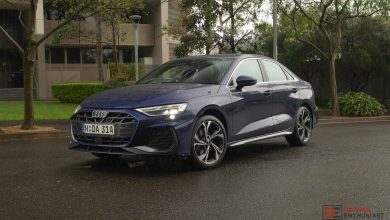
This is Audi’s electric era in full swing, and the Q6 e-tron rolls in with the features and finesse to prove it. It marks a confident evolution for Audi, blending luxury with strong EV performance and a thoroughly modern cabin. If electric SUVs were judged purely by screen count, this one would be in pole position.
The Q6 e-tron slots between the Q4 and Q8 e-tron, and introduces the brand’s new PPE platform to this segment, promising meaningful gains in driving range, refinement, and digital simplicity. But with a price tag north of $120k, and increasingly polished competition from BMW, Mercedes-Benz, Lexus, and Volvo, expectations are high. After a week behind the wheel, we found its strengths and some potential compromises that buyers should know before signing on the dotted line.

2026 Audi Q6 e-tron e-quattro: Specifications
Electrical: 100kWh battery, 2x electric motors
Output: 285kW / 275Nm + 580Nm
Gearbox: Single-speed auto
Drive type: All-wheel drive
Wheels: F: 20×8.5, 255/50 R: 20×10, 285/45
ANCAP: Not tested
Tare weight: 2525kg
Power-to-weight: 8.85:1 (kg:kW)
Official range (NEDC): 542kmMax charging AC/DC: 7.2kW/270kW
0-60km/h: 2.98 seconds*
0-100km/h: 5.42 seconds*
60-110km/h: 3.25 seconds*
1/4 mile: 13.65 seconds at 172.9km/h*
Max acceleration: 0.948g*
100-0km/h braking: 37.34m in 3.08 seconds*
Max deceleration: -1.159g*
Starting price: $122,500
*Figures as tested by Driving Enthusiast on the day. Manufacturers’ claims may be different
2026 Audi Q6 e-tron e-quattro: How much does it cost?
The Q6 e-tron e-quattro sits in the middle of the broader Q6 e-tron family, priced from $122,500 before on-road costs. It lands above the rear-wheel-drive entry point at $99,900, and below the performance-oriented SQ6 which stretches to $156,400.
You can opt for a ‘Tech pro’ package that throws in adaptive air suspension, digital OLED taillights, and an electric steering column for $4900. There is also a $3600 ‘Style’ package, which adds larger 21-inch black metallic sports alloys wheels, black exterior embellishments, and privacy glass. Thirdly, a ‘Premium’ package is also on the table, offering a panoramic glass sunroof, augmented reality heap-up display, a premium Bang & Olufsen 3D sound system, interior ambient lighting with dynamic interaction, USB ports with higher charging capacity, and acoustic glaze front door windows for $8900.
Although it is far from the budget-friendly end of the segment, the Q6 e-tron quattro offers competitive value against its rivals on the basis of performance, range and included technology. A BMW iX xDrive45 M Sport retails for $143k, and the bigger Volvo EX90 Ultra Twin Motor Performance is positioned at $134,990.
Running costs are straightforward: Audi offers a six-year service plan for $2080. This covers three services at 24-months or 30,000km intervals thanks to the reduced maintenance requirements of EV powertrains. Warranty coverage is average, with five years/unlimited kilometres, eight years/160,000km for the high-voltage battery, and 12-years of body corrosion cover. Six years of roadside assistance is also thrown in.

2026 Audi Q6 e-tron e-quattro: Interior & packaging
Audi has framed the Q6 e-tron cabin as a new design era, and it certainly feels fresh, blending sweeping horizontal lines with bold illumination themes and a curved dual-screen interface. Material quality is generally solid, with well-fitted surfaces and a pleasant mix of soft textures.
The layout is dominated by a large 14.5-inch central touch-screen, an 11.9-inch Virtual Cockpit cluster, and a separate 10.9-inch passenger display. While the displays themselves are crisp and responsive, the passenger screen verges on gimmickry. Realistically, most front passengers could simply use the central display that sits within arm’s reach. And unlike any modern vehicle, the Q6 strangely omits an exterior temperature readout.

Physical controls are present, but many incorporate haptic feedback rather than mechanical actuation. The sensitivity varies, making some buttons longer to find without visually confirming them, especially those placed closely together. For a car marketed around digital simplicity, we think this introduces a layer of friction that could’ve been avoided with more tactile switchgear.
Space is impressive in both rows. The Q6 e-tron offers generous legroom and headroom even with the optional panoramic roof, and entry/exit is easy thanks to wide apertures. Though, swinging the doors in and out from the inside feels awkward. The grab handle is further to the front/hinge of the door, which causes a lack leverage from the inside; and in the wind, it is easy to lose control of the door. You also have to slam the doors, and they don’t sound refined on closure.

Boot space is practical and square. There are handy side nets and an elastic band to help restrict loose cargo. The space is also complemented by a 64-litre front storage compartment under the bonnet. Inside the cabin, storage is practical, with modest cupholder and centre console proportions. But it is not class-leading for EV standards. Many EVs have huge under console spaces; the Q6 is laid out more like a combustion engine SUV.
Safety is thoroughly addressed. Every Q6 receives a full suite of high-end assistance systems, including adaptive cruise with stop-and-go, lane guidance, 360-degree cameras with kerb view, proactive occupant protection, blind-spot monitoring, rear occupant detection, exit warning, park assist, and nine airbags, including a centre airbag.

Other notable features that come stock standard include leather electric seats, heated front and rear outer seats, three-zone climate control, digital key using a smartphone, Audi connect plus (car finder, emergency calling, remote charging and remote climate control), wireless app connection, an adaptive cooling wireless phone charger, and a 10-speaker Audi sound system with subwoofer.
Externally, the Q6 quattro strikes a clean, modern profile with sharp detailing, muscular contours and remarkably advanced lighting technology. Audi’s digital matrix LED headlights with active shadowing are a standout feature – not just for their futuristic appearance but for how precisely they block out surrounding vehicles while maintaining maximum forward visibility. It’s one of the most impressive lighting systems we’ve seen. Then there are the digital OLED rear lights with configurable signatures that are included in the Tech Pro package.
Towing capacity is rated at 2400kg (braked), which is decent for an EV, but not among combustion engine SUVs, which can pull up to 3500kg, even in the premium class.

2026 Audi Q6 e-tron e-quattro: Powertrain & handling
The Q6 e-tron quattro features dual electric motors delivering 285kW and up to 580Nm, enabling brisk, confident performance in everyday conditions. All this happens thanks to a 100kWh lithium-ion battery system. Take-off is immediate, with a strong swell of torque that makes the SUV feel effortlessly swift.
The linearity of the motors allows easy modulation, and it feels particularly at home during rolling acceleration, where instant torque fills gaps left by traditional transmissions. The 0-100km/h sprint is officially claimed in 5.9 seconds. Not the fastest EV you’ll find on the market, but fast enough. Our tests clocked it in 5.42 seconds.
Charging performance is equally strong thanks to its 800-volt architecture. Under ideal conditions, the Q6 can replenish from 10–80 per cent in just over 20 minutes, and a short 10-minute stop can add well over 200km of real-world driving range.

A full charge will have you travelling 542km under the NEDC test. Audi’s thermal management and battery conditioning systems work seamlessly in the background to keep charge speeds consistent. Max charge capacity is 270kW with DC power, and up to 7.2kW (AC) single phase charging at home. It’s worth noting here that the Kia EV9 and Hyundai IONIQ 9 are now pushing 350kW DC charging speeds, as well as others.
Despite its powertrain strengths, the Q6 quattro feels undeniably heavy on the road. With a kerb weight of 2525kg, there is noticeable mass transfer under braking and through longer bends, and the suspension struggles to fully mask its size. Over patchy or broken surfaces, the ride can feel abrupt, with the chassis sometimes crashing over sharper imperfections rather than absorbing them cleanly. Though, this isn’t unusual among large, performance-skewed EV SUVs.

The braking system also needs a little refinement in our opinion. While stopping power is strong, pedal feel variably changes depending on how much regenerative braking is occurring. This can make it hard to achieve a smooth, consistent brake squeeze at lower speeds – another symptom common in EVs, but more noticeable here we feel.
Steering is light but accurate, offering predictable responses at urban speeds and decent feedback on country roads. It doesn’t disguise the bulk of the vehicle, but it does make manoeuvring easy. Refinement is a mixed bag; wind noise is impressively subdued, but tyre noise can vary depending on the road surface.

2026 Audi Q6 e-tron e-quattro: Key attractions/reasons to buy
- Strong performance: Dual motors deliver effortless torque, surging acceleration and relaxed overtaking confidence.
- Impressive lighting technology: Digital matrix headlights with active shadowing are among the most advanced and effective we’ve seen.
- Spacious, modern cabin: Excellent rear-seat room, a useful ‘frunk’, and clean new-generation digital displays.
- Competitive running costs: Low servicing cost across six years, strong warranty coverage and long service intervals.
- Add-ons: The add-on packages available allow for a more exclusive feel; air suspension, upgraded sound, and an augmented reality heap-up display, for example.
2026 Audi Q6 e-tron e-quattro: Key considerations before you buy
- Heavy on the road: Noticeable weight shift and abrupt suspension reactions over sharper bumps.
- Brake pedal inconsistency: Regeneration integration makes low-speed inching feel less precise.
- Haptic controls: Many buttons lack meaningful tactile separation, forcing you to look down more often than ideal.
- Doors feel unrefined: They require a firm close, with a sound and feel not consistent with typical Audi solidity.
2026 Audi Q6 e-tron e-quattro: Video


How does it rate against its rivals?
- Price
- Quality look & feel
- Interior tech
- Powertrain performance
- Ride & handling
- X-factor (does it stand out in its class?)
Final word
The Audi Q6 e-tron e-quattro delivers sturdy performance, leading-edge lighting technology, and a spacious, modern interior. But is that enough? It’s sophisticated where it matters less. On the road, its considerable weight, inconsistent brake feel, and some usability ergonomics have it aligned with the driving pleasure levels of some other newcomer EVs on the market. It’s easy to be bedazzled by all the digitisation and fancy screens, but any car company can offer that for a cheap price nowadays. However, special options packs can transform this into a more exclusive package.