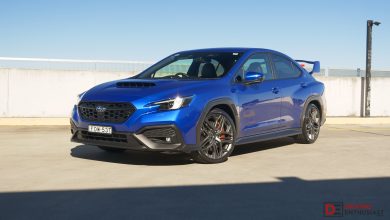
Subaru hasn’t tried to revolutionise the new sixth-generation Forester so much that it alters the qualities that have kept it a staple on Australian roads for more than 25 years. Visibility, practicality, all-weather confidence, affordability, and honest usability continue to sit at its core.
The sixth-generation model sees four variants on offer: AWD, AWD Premium, AWD Sport, and AWD Touring. It also now brings two distinct powertrains. One leans into familiar petrol performance, and the other showcases Subaru’s new hybrid technology paired with permanent mechanical AWD; an Australian-first combination.
Despite a familiar silhouette, the new Forester sees meaningful upgrades under the skin, including revised steering, improved ergonomics, expanded driver-assist tech and a stronger emphasis on long-distance range.
After spending a week each with both powertrains in the AWD Sport and the range-topping Hybrid Touring, we compare the two, and give the spill on whether the new Forester still earns its reputation as one of the most honest and capability-stacked family SUVs in its class.

2026 Subaru Forester Sport 2.5: Specifications
Engine: 2.5-litre petrol flat four-cylinder
Output: 136kW@5800rpm / 247Nm@3700rpm
Gearbox: CVT auto
Drive type: All-wheel drive
Wheels: F & R: 18×7.0, 225/55
ANCAP: Five stars
Tare weight: 1611kg
Power-to-weight: 11.84:1 (kg:kW)
Official consumption: 7.9L/100km
Our consumption: 7.8L/100km
Fuel tank/Fuel type: 63L/91 RONPower efficiency: 17.21kW:L/100km
0-60km/h: 4.72 seconds*
0-100km/h: 9.45 seconds*
60-110km/h: 6.37 seconds*
1/4 mile: 17.04 seconds at 137.0km/h*
Max acceleration: 0.572g*
100-0km/h braking: 41.79m in 3.47 seconds*
Max deceleration: -1.046g*
Decibel at idle: 38*
Peak decibel at 60-100km/h: 78*
Starting price: $48,490
2026 Subaru Forester Touring Hybrid: Specifications
Engine: 2.5-litre flat four-cylinder hybrid
Output: 145kW / 276Nm + 212Nm
Gearbox: CVT auto
Drive type: All-wheel drive
Wheels: F & R: 19×7.5, 235/50
ANCAP: Five stars
Tare weight: 1726kg
Power-to-weight: 11.90:1 (kg:kW)
Official consumption: 6.2L/100km
Our consumption: 5.9L/100km
Fuel tank/Fuel type: 63L/91 RONPower efficiency: 23.38kW:L/100km
0-60km/h: 4.19 seconds*
0-100km/h: 9.28 seconds*
60-110km/h: 6.84 seconds*
1/4 mile: 16.78 seconds at 133.3km/h*
Max acceleration: 0.560g*
100-0km/h braking: 43.01m in 3.31s*
Max deceleration: -1.116g*
Decibel at idle (on standby): 23*
Peak decibel at 60-100km/h: 77*
Starting price: $55,990
*Figures as tested by Driving Enthusiast on the day. Manufacturers’ claims may be different

2026 Subaru Forester: How much does it cost?
Pricing for the new Forester is bunched within a small bracket that ranges only $12k. It starts from $43,490 and tops out at $55,990 (excluding on-road costs). Notably, opting for the hybrid technology does not add a flat fee across the range. For example, it adds $3k in the base model, $6.5k in the mid-range Sport, and $5k in the Touring. That’s because the feature list varies across the two powertrains with the same variant. So you’re not comparing apples with apples with the same grade name.
Our tested models here start from $48,490 for the AWD Sport, and the range-topper $55,990 Hybrid Touring.
In terms of segment value among those that push all four wheels, Subaru’s numbers remain competitive. A Toyota RAV4 hybrid starts at the same price as the Forester and pushes into the high-$50k region, while the cheapest Honda CR-V AWD is more expensive, at $52k, and $60k for the single hybrid variant, the e:HEV RS.
Nissan X-Trail’s cheapest AWD variant undercuts at $40k, but peaks at $57k with its e-Power Ti-L. Subaru’s proposition – standard mechanical AWD, extensive safety, and hybrid efficiency – stacks up convincingly against this backdrop. There are cheaper options like the MG HS and the GWM Haval H6, but you lose four-wheel drive.
Ownership costs are transparent on the Japanese-built SUV. Subaru maintains 12-monthly or 15,000km service intervals across the lineup. Capped-pricing on the first five services are reasonable, costing $347.95, $520.45, $393.10, $679.30, and $358.20 for both powertrains. Though, there are no pre-paid service plans available to make these cheaper. Subaru also continues to offer its long-standing five-year, unlimited-kilometre warranty, and 12 months of roadside assistance.

2026 Subaru Forester: Interior & packaging
Inside, the Forester maintains a familiar and function-first approach. The cabin still features layered surfaces, chunky textures and multiple contrasting panels, presenting a more rugged and purposeful aesthetic than the clean, minimalist directions taken by some rivals. For drivers who like the tactile certainty of a physical control, almost everything is represented by a button or switch. This abundance of hardware won’t suit everyone’s tastes, but it undoubtedly appeals to buyers who are tired of buried essential functions in touch-screen submenus.
Distinctively, there are a few different seat trims and colours across the board. Our petrol Sport has practical water repellent seat trim, living up to its variant name. Then the Hybrid Touring scores a more elegant mix of leather accents with Ultrasuede. At this end, you can choose black or a mix of brown and black.

Ergonomically, the sixth-generation Forester is significantly improved. The lower dashboard line and expansive glasshouse create excellent outward visibility, with the side windows sitting lower than most SUVs to enhance the sense of situational awareness. The seating position is natural and supportive, and both the Sport Petrol and Hybrid Touring provide a driving environment that feels intuitive from the moment you settle in. Surprisingly, heated front seats are standard across the fleet. Then only the Touring scores ventilated front seats.
Interior space is generous across both rows. The Forester continues to excel in headroom, legroom and overall comfort, allowing tall adults to sit comfortably in the second row with room to spare. Entry and exit remains easy thanks to the high seat base and wide door apertures. Cup holders, the centre console, gear selector, and door pockets are primitive in design, but practical.

Boot capacity is similarly practical, offering a broad, square luggage area with multiple hooks and it accommodates large items with little fuss. The all petrol variants tuck in 496 litres or 1174L with the rear seats folded. Even with the hybrid packaging, only 12L of cargo volume is lost. But they get away with this by dropping the full-sized spare wheel from the all-petrol variants for a puncture repair kit in the hybrid. There is an accessory solution available for hybrid vehicles if you must have a spare.
Technology centres around the 11.6-inch portrait touch-screen, which presents a clear layout with logically spaced menus. While functionality is strong, the graphics look a little chunky compared with more modern units among competitors. Wireless smartphone integration, multiple USB-A and -C ports in both rows and wireless charging help modernise the cabin experience.

The Hybrid Touring also adds a 12.3-inch fully digital instrument cluster, displaying trip information, media, and hybrid energy flow in a more contemporary format. Audio performance is heightened in the Touring, Hybrid Sport and Hybrid Touring, with a 10-speaker Harman Kardon sound system, upgraded from the standard six-speaker system. It leans heavily into bass resonance, creating a warm sound signature that some may enjoy while others might wish for more treble sharpness.
Safety is one area where Subaru continues to lead the game forward. The latest Forester introduces the next generation of Subaru’s ‘EyeSight’ with a wider-angle camera, improved detection of pedestrians and cyclists, and smoother adaptive cruise performance. We also found that the driver monitoring alerts were more reasonable in terms of accuracy, and less intrusive than earlier versions. It works alongside nine airbags, a 360-degree surround-view camera including a front-view monitor, blind-spot monitoring, lane-centring, reverse auto braking, and emergency stop assist. And all this is standard across the board.
Externally, Subaru has chosen evolutionary rather than transformative styling. The silhouette remains instantly recognisable, but details such as the merged taillight signature and an increased use of contrasting black trims, particularly on the Sport, subtly modernise the look. Green accents and small adventure-themed easter-eggs embedded into the glass and trim help add personality. The result isn’t dramatically different from the previous model, but it looks incrementally cleaner and a touch more purposeful.

2026 Subaru Forester: Powertrain & handling
The distinction between the Sport Petrol and Hybrid Touring becomes clearer once on the move. The 2.5-litre four-cylinder petrol engine in the Sport offers brisk initial response and throttle sensitivity, feeling lighter and more eager than its output suggests. It gets by with 136kW/247Nm. Our tests clocked 0-100km/h in 9.45 seconds.
In stop-start conditions, however, the initial throttle sensitivity can make it tricky to maintain a perfectly steady pace; the pedal occasionally feels jumpy until you adapt. Once flowing with traffic, the engine feels smooth and willing, supported by a ‘Lineartronic’ CVT gearbox that Subaru claims has been retuned for better take-off and more natural simulated shift points.

Average fuel consumption of 7.9L/100km is expected for a full-time AWD SUV. Our average over a week of mixed driving showed a similar average of 7.8L/100km.
In contrast, the Hybrid Touring introduces Subaru’s new e-Boxer powertrain, blending the same 2.5-litre engine with a more powerful electric motor for a slightly increased combined output of 145kW – nearly 32 per cent more than the outgoing mild-hybrid system.
Our 0-100km/h tests saw a best time of 9.28 seconds. Stronger low-speed torque is the most noticeable factor (276Nm from the electric side alone), allowing quieter and more assured take-off. The improved hybrid integration also makes transitions between electric and petrol power far smoother, enhancing refinement.

It receives an official average consumption of 6.2L/100km and our testing scored even better, with 5.9L/100km. The benefit is also noticed with a greater potential range of around 1000km. The hybrid represents a substantial step up in touring efficiency without compromising the full-time AWD hardware that remains the Forester’s calling card.
Ride quality is also the Forester’s party piece. That is, both variants use softer suspension tuning, which produces plush compliance over potholes, corrugations and broken surfaces. It’s a setup that favours long-distance comfort and mild off-road confidence over taut, sporty handling. Some rivals feel more tied down on twisting roads, but few match the Forester’s blend of comfort and capability on gravel or country backroads.
Steering sees a notable improvement thanks to Subaru’s WRX-derived dual-pinion system. Feel is clearer and more natural, improving mid-corner stability and reducing the slightly loose sensation of the previous model. The Forester feels secure and planted in everyday conditions, even if outright athleticism isn’t the priority.

Refinement sees both gains and compromises. Engine and wind noise are well controlled, especially in the hybrid, but road noise on coarse-chip Australian highways remains more pronounced than ideal. Subaru’s sound insulation upgrades help, but tyre roar still intrudes at speed.
It goes without saying that every variant receives Subaru’s famous and always-on Symmetrical All-Wheel Drive system. Many cheaper alternatives mask savings by only offering power to the front wheels. To keep the Forester up to the job of soft off-road duties there is a healthy 220mm of ground clearance, as well as an ‘X-Mode’ off-road driving mode, and hill descent control.

One pitfall on the hybrid powertrain is the significantly reduced towing capacity from 1800kg to just 1200kg. The Forester has a fairly weak towing capability to start with, and for it to be reduced by another 33 per cent is a blow to what shapes Aussie holidays for many. With that, tow ball download also drops from 180kg to 120kg.
What powertrain is the pick? If you’re planning on lots of long-distance touring, we think the petrol is the one to go for. It has a proper spare wheel and is less fuss on the highway. Fuel savings are not going to be a big on the highway, in face, the official highway consumption rate is 6.7L/100km in the petrol and 6.0L/100km in the hybrid. Conversely, if you’re only running around in town, then the hybrid makes more sense as it can rely more on the electric motor assist. The lack of a spare tyre is not going to be as much of a concern and you always have roadside assist as well.

2026 Subaru Forester: Key attractions/reasons to buy
- Real-world efficiency and value from the hybrid: There is a full 2.0L/100km improvement from the hybrid, and you gain more power. It can also realistically achieve 1000km on a tank while retaining full-time mechanical AWD.
- Ride comfort: Soft, compliant suspension that smooths out rough country roads and unsealed surfaces with ease while maintaining composure and stability.
- Outstanding visibility: Huge glasshouse, low window lines and an excellent driving position make it one of the easiest SUVs to see out of.
- Button-heavy cabin: Physical switchgear for almost every function appeals to drivers who dislike touch-screen-heavy systems.
- Comprehensive safety: Latest EyeSight with wide-angle camera, Emergency Driving Stop System (EDSS), lane support, 360-degree camera and nine airbags. And these features exhibit good accuracy without being overly sensitive.

2026 Subaru Forester: Key considerations before you buy
- Sensitive throttle: Petrol models can feel jumpy at low speeds until you acclimatise.
- Cabin noise: Road roar on coarse surfaces is louder than many competitors.
- Conservative redesign: Exterior and interior both feel evolutionary rather than new. And the screen menus are rather chunky with not much style compared with others.
- Hybrid loses spare wheel: The repair kit supplied is only effective for small punctures in the tread and won’t help you with full blowouts.
- Soft dynamics: Suspension tuning prioritises comfort over sporty handling, which might not suit every driver.
- CVT auto: These types of transmissions are quite boring and some have been involved in class-action lawsuits due to reliability concerns.
2026 Subaru Forester: Videos


How does it rate against its rivals?
- Price
- Quality look & feel
- Interior tech
- Powertrain performance
- Ride & handling
- X-factor (does it stand out in its class?)
Final word
The Forester Sport Petrol and Hybrid Touring may take different approaches to performance and efficiency, but both capture the nameplate’s enduring strength and exceptional usability via great visibility, high levels of safety, constant all-wheel drive, and good interior practicality. The hybrid introduces meaningful gains in efficiency, real-world driving range, and performance, without asking for a huge premium. Neither variant dramatically reinvents the Forester, but together they reinforce its reputation as one of Australia’s more dependable, familiar mid-size SUVs that doesn’t mind a little adventure.