

In 2017, Toyota ceased manufacturing in Australia – an unprecedented factory closure in a western country. This event was triggered by the withdrawal of the Automotive Transformation Scheme’s (ATS) second wave of funding, which Holden was relying on to continue producing cars to 2022. After Holden announced its exit in 2013, Toyota followed suit due to the collapse of the automotive supply chain. But what if it continued producing the Camry and Aurion here?

Six-cylinder sedans have fallen out of favour with mainstream Aussie consumers, with such powertrains being reserved for more premium brands now. For the purpose of today’s exercise, we’re imagining a parallel universe where Toyota continued building the Aurion in Australia, with a top-of-the-line GR Aurion successor to the TRD Aurion (2007-2009) as a flagship to the range, based on the current XV80 Camry. There isn’t really a sporting Camry on offer at the moment globally, but Toyota did reveal a very tasty concept at this year’s SEMA show.
Seeing as the Camry has now moved to a hybrid-only platform, it’s only right we seek to maintain this, while also imbuing our hypothetical GR Aurion with the six-cylinder power it deserves. So where in the current Toyota world does such a powertrain exist?

In the USA, a seven-seat Lexus known as the TX 550+ combines the 2GR-FXS V6 with front and rear electric motors for a combined system output of 300kW. That seems like a juicy target for our car. There would be a few hurdles to overcome, however.
Firstly, the big Lexus crossover is a plug-in hybrid, meaning the Camry Hybrid’s tiny 1.0kWh battery would not be enough to supply the gruntier rear electric motor of its e-4WD system. We would therefore want to upgrade the battery pack to at least 3kWh, which might necessitate some repositioning of the rear passenger seat.

The 2025 Camry AWD’s front 100kW and rear 30kW e-motors are not worthy of the GR badge, so we’d seek to upgrade those to 140kW and 80kW, respectively, which would also mean more prodigious cooling requirements. To give the powertrain a sporting edge, raising the rev-ceiling to 7200rpm, a bimodal quad exhaust to hear the 2GR’s delicious note and 98 RON tune could lift power to 205kW and 350Nm from 193kW/335Nm of the standard Atkinson-cycle V6. Paddle shifters for the e-CVT would also be a non-negotiable to enhance this car’s sporting pedigree.
Handling duties would be taken car of via uprated springs, front and rear strut bracing as well as adaptive dampers. For braking, six-piston front monoblock calipers with 380mm two-piece vented rotors at the front and four-piston jobbies at the rear clasping 355mm vented rotors would pull the big dawg up nicely. Brake cooling ducts would also be a necessity. Continental Sport Contact 7’s – as equipped on the Lexus LBX Morizo RR – could be the ideal tyre choice to maximise all-wheel grip, while giving the best all-round performance for wet weather, refinement and braking.

Local tuning with regards to power distribution would incorporate torque vectoring, with maps of racetracks such as Bathurst loaded into the system, letting the car optimise grip for every corner.
How would we differentiate the Aurion from the Camry? Well, a large grille opening would give it that Australian sedan look, but big lamp clusters would be at odds with Toyota’s current aesthetic. We’d counter that with liberal use of LED clusters in the headlamps as well as vertical units in the air curtains, as shown in our AI-generated images.
A slick carbon fibre front apron gives the car a very unique and finished appearance (just don’t get into a shunt at Woolies or you’ll be paying a fortune), while accentuating the Camry’s inherent goodness. Rear ‘Altezza’ style lamp clusters, a cracking body kit and multi-spoke anthracite alloys set the look off nicely, as well as the blackout ‘floating’ roof.
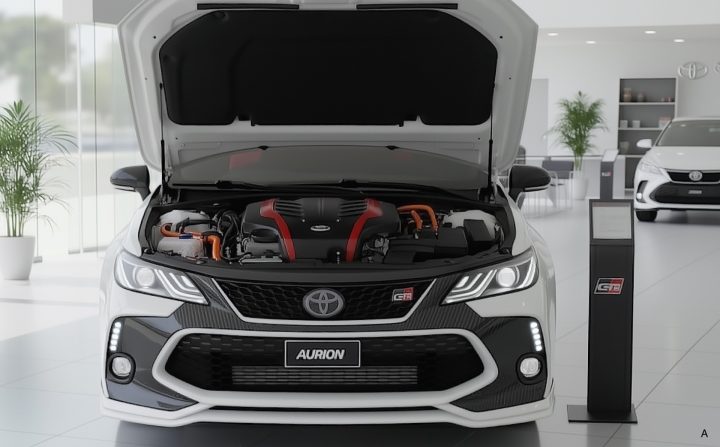
Speculative Specs:
Engine: 3.5-litre naturally-aspirated V6 hybrid (2GR-family), D-4S, 98 RON tune, freer-flowing intake, valved performance exhaust, uprated valve springs and oil control, 7200rpm redline
Output: 205kW / 350Nm (petrol engine), 140kW (front e-motor) / 80kW (rear e-motor)
Electrical: Lithium-ion 2-4kWh high-power hybrid battery~350V architecture, liquid-cooled battery and inverters, uprated rear e-Axle cooling
Output (combined): 315kW
Gearbox: eCVT (power-split) with paddle shifters operating GR-specific stepped shift simulation and enhanced engine-braking maps
Drive type: Electronic AWD (DIRECT4-style) with uprated propulsive rear eAxle
Front wheels: 19 x 8.5J, 255/35 ZR19 Michelin Pilot Sport 4S
Rear wheels: 19 x 9.0J, 285/35 ZR19 Michelin Pilot Sport 4S
ANCAP: Five stars
Tare weight: 1780kg (est)
Power-to-weight: 5.87:1 (kg:kW)
Official consumption: 6.2L/100km
Fuel tank/Fuel type: 50L/98 RON
Power efficiency: 46.9kW:L/100km
0-100km/h: 4.6 seconds
Starting price: $82,990

Feasibility: 8/10
All the hardware exists, the only gaps being the additional cooling hardware and adapting PHEV hardware to a regular hybrid application. The other hurdle would be making room for the larger battery. Australian engineering capability is still top-notch so there is no doubt this could happen if Toyota still made cars here.
Probability 0/10
Toyota no-longer builds cars in Australia anymore, so the market segment that created the Aurion in the first place is no longer a real thing.
Still, with the 2025 Camry GT-S concept shown at SEMA, the probability of a hot Camry remains possible. That concept car had a blacked out bonnet, colour-shifting gold paint and some tasty bodykit additions. Uprated brakes and tyres, too, but no powertrain modifications to the standard 2.5-litre hybrid setup. This will probably translate more to the USDM Camry than the Japan-sourced model we now receive. But we are confident there would at least be an appetite for such a car. What do you think?
@paralleluniversec What if #toyota still made the #aurion in a #gr version? 🤔 #ausdm #paralleluniversecars ♬ original sound – Parallel Universe Cars

